
I had a great week with Tash and Jake a few years ago, exploring the trad quartzite climbing on offer in the Jebel Kest mountains in Morocco. You’ll find some posts from that Rock The Kasbah trip starting here:
For the return visit I teamed up with Paul, Andy and Graham, with a two-centre schedule starting in Tafraout for 3 days then spending the remaining 4 nights at Kasbah Tizourgane on the north side of the range. Mid-April is probably as late as you’d want to plan a trip, with temperatures in the high 20s, clear blue skies and a blazing sun, so shady crags are essential. Unsurprisingly, these are at a premium around Tafraout (on the south side of Jebel Kest) and we actually ended up driving halfway back to the Kasbah to the East-facing Greek Buttress near Sidi M’Zal for our first route.
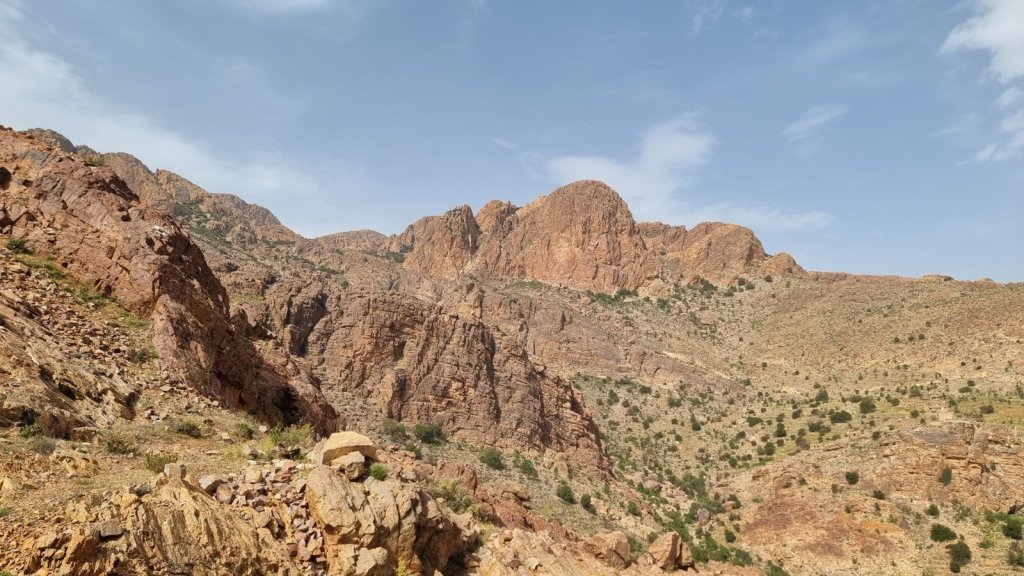
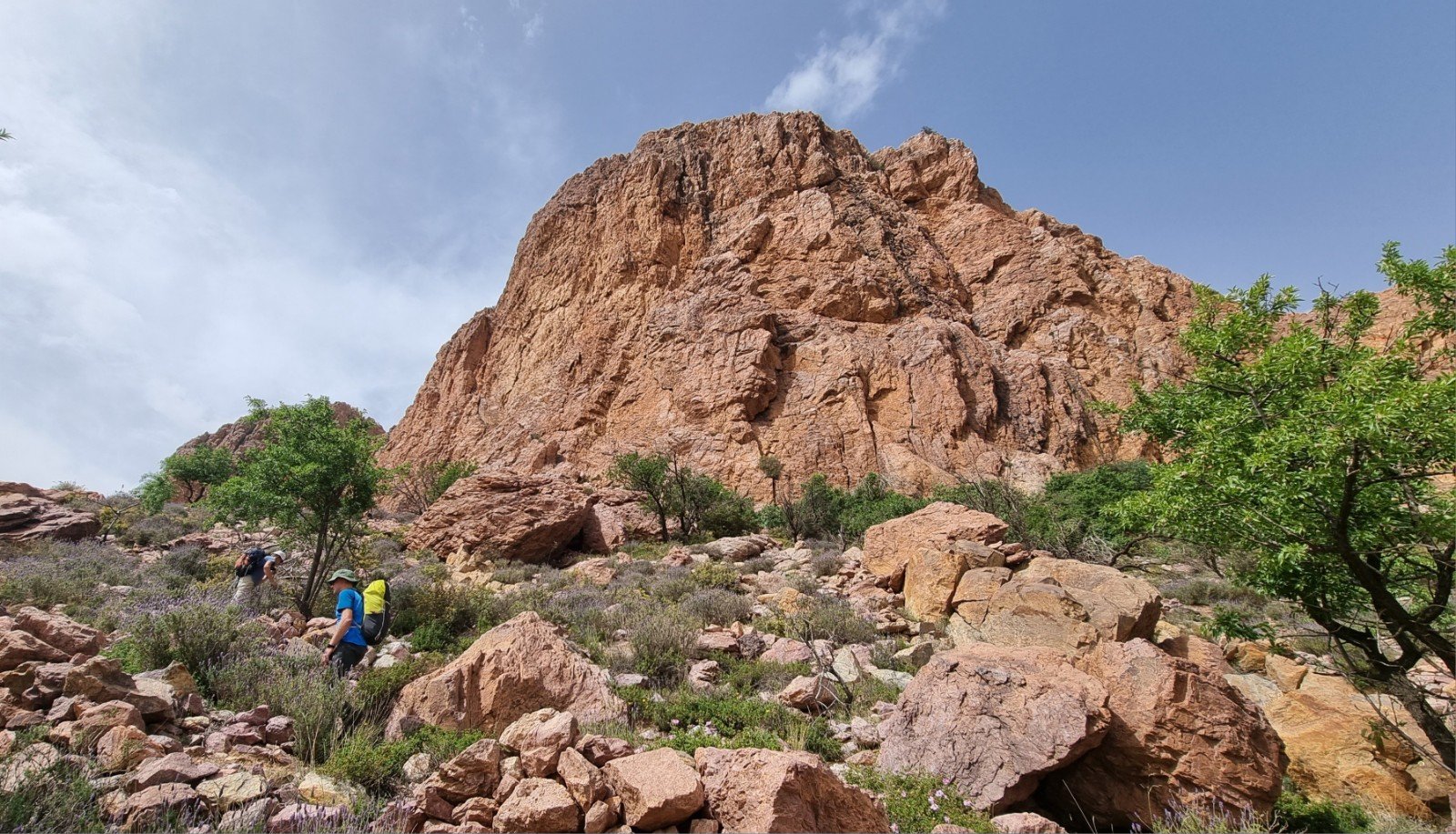
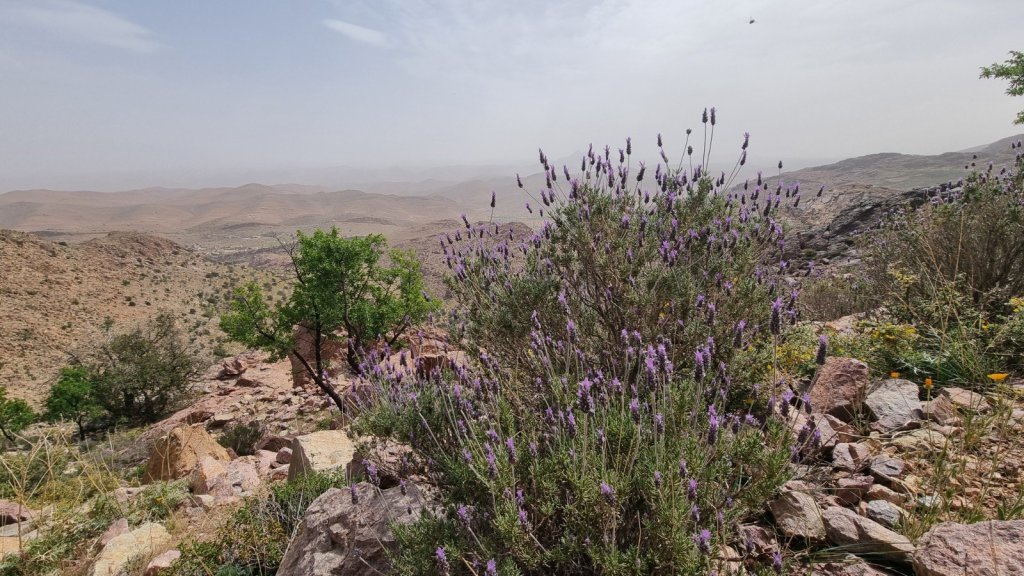
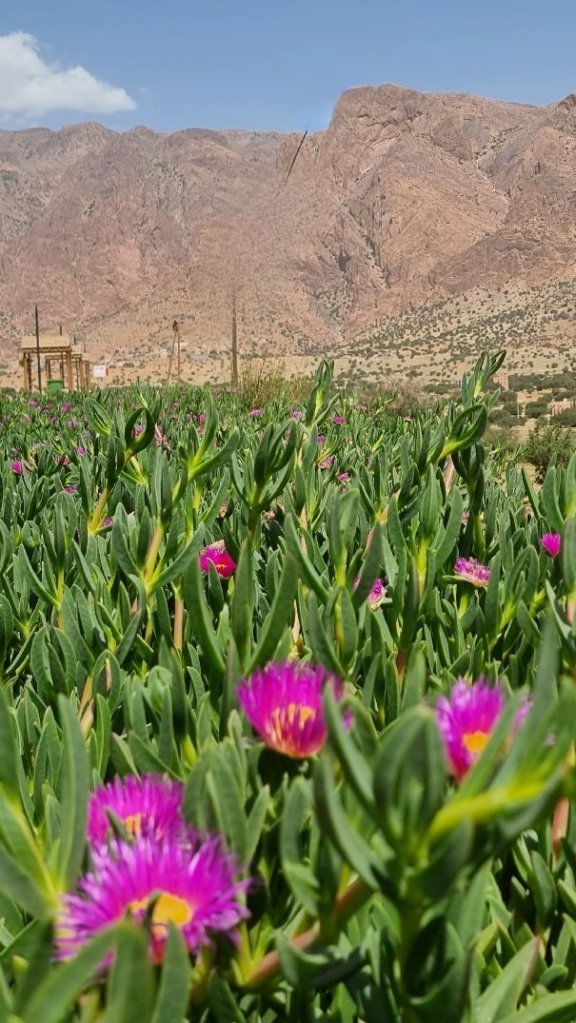
Graham recommend Eros to Paul and me, a 4-pitch E2 5b, while he and Andy did the adjacent Aphrodite at the same grade. With an overall length of 215m you can do the maths to work out they’re all rope-stretching pitches. It’s about an hour’s approach, through prickly, rocky terrain, studded with spectacular desert flowers.
Here are me and Andy starting up the first pitches
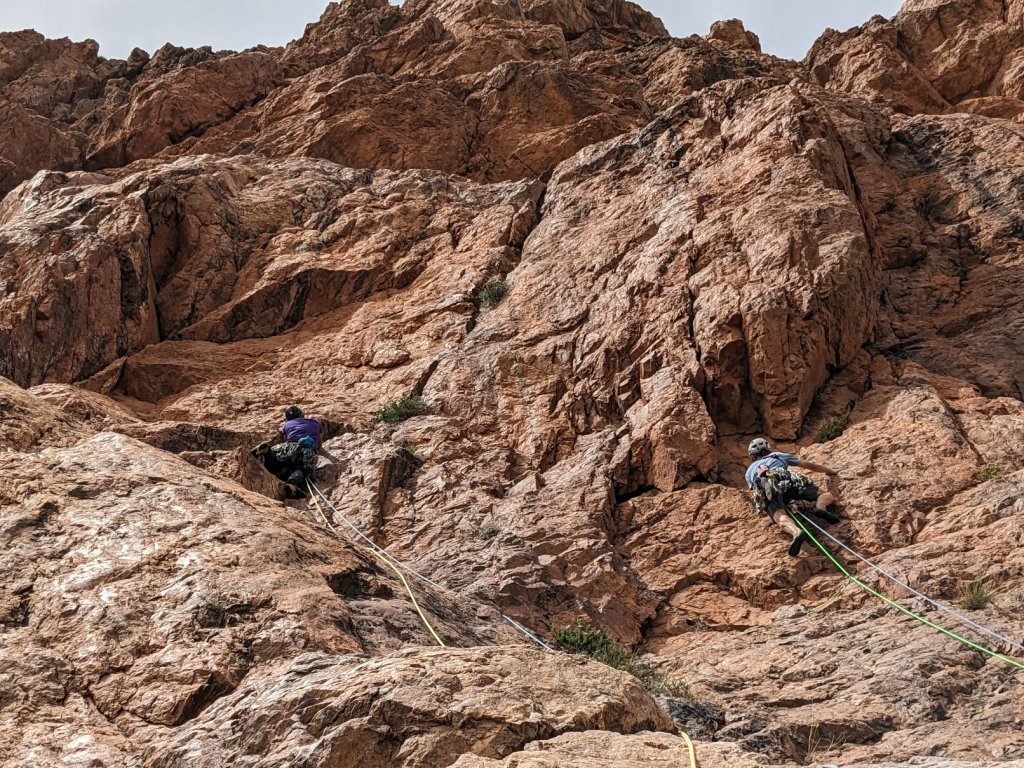
The meat of P1 is a steep crack (hint – run out the full 60m to arrive at the correct ledge).
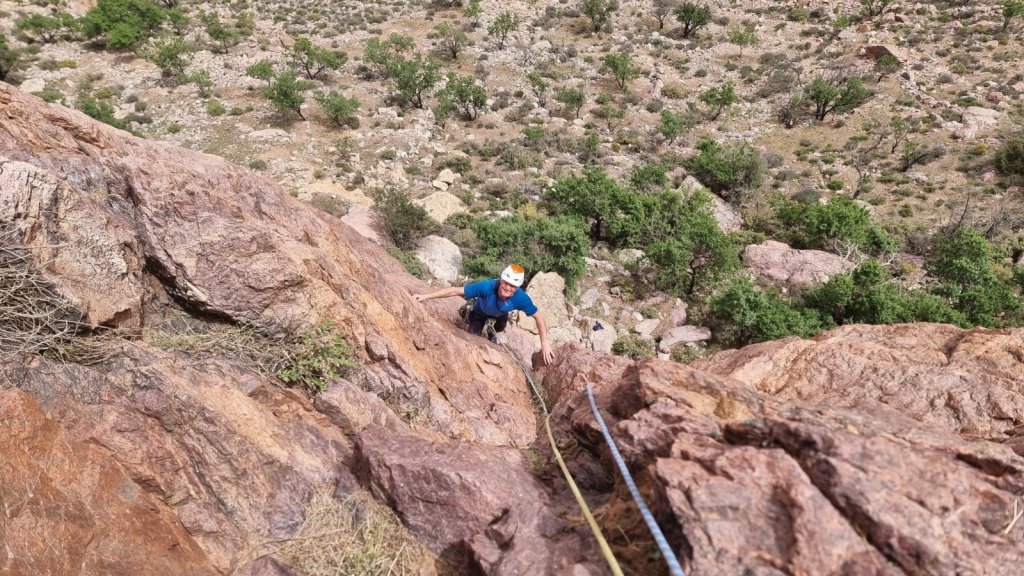
P2 starts with a fun undercling sequence around a bulge before romping up a wall to some more burly moves through a steepening.

Me following P2
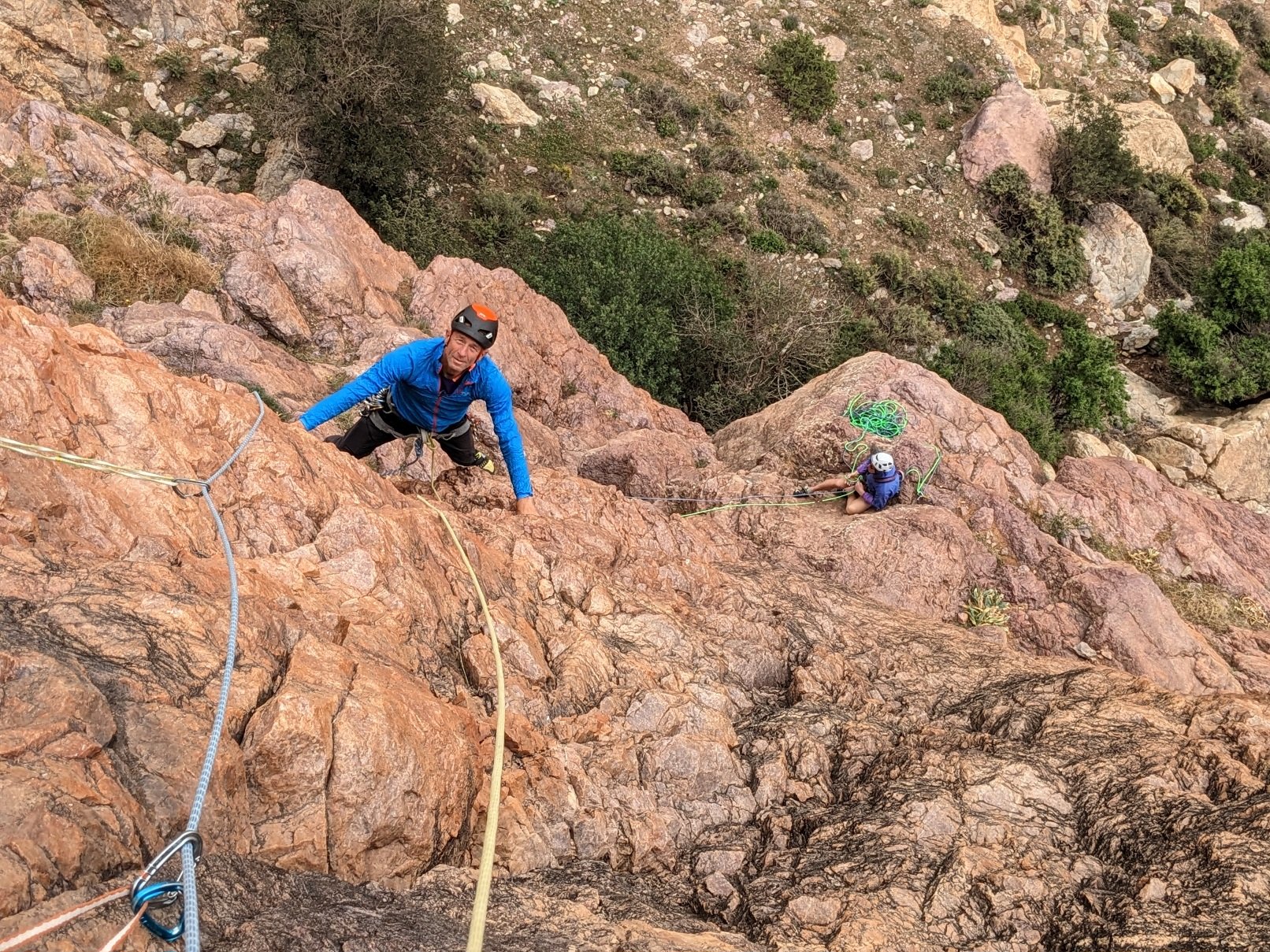
P3 culminates in a perplexing diagonal slot, and P4 builds to a fitting crescendo. All excellent, arguably getting better and better as height is gained, with good if spaced gear and not too taxing at the grade.
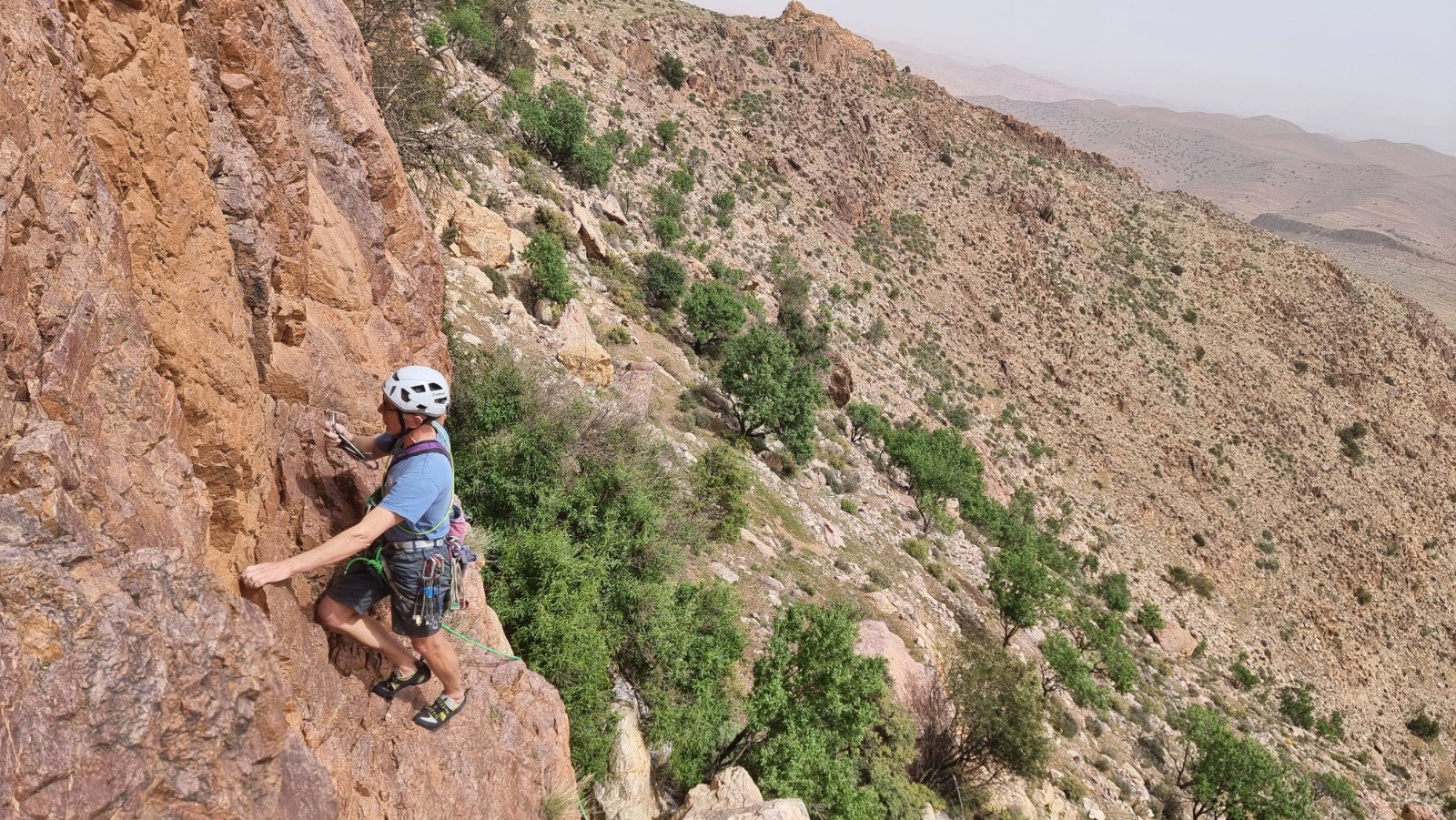
Here are a couple of shots looking across to Andy on P1…
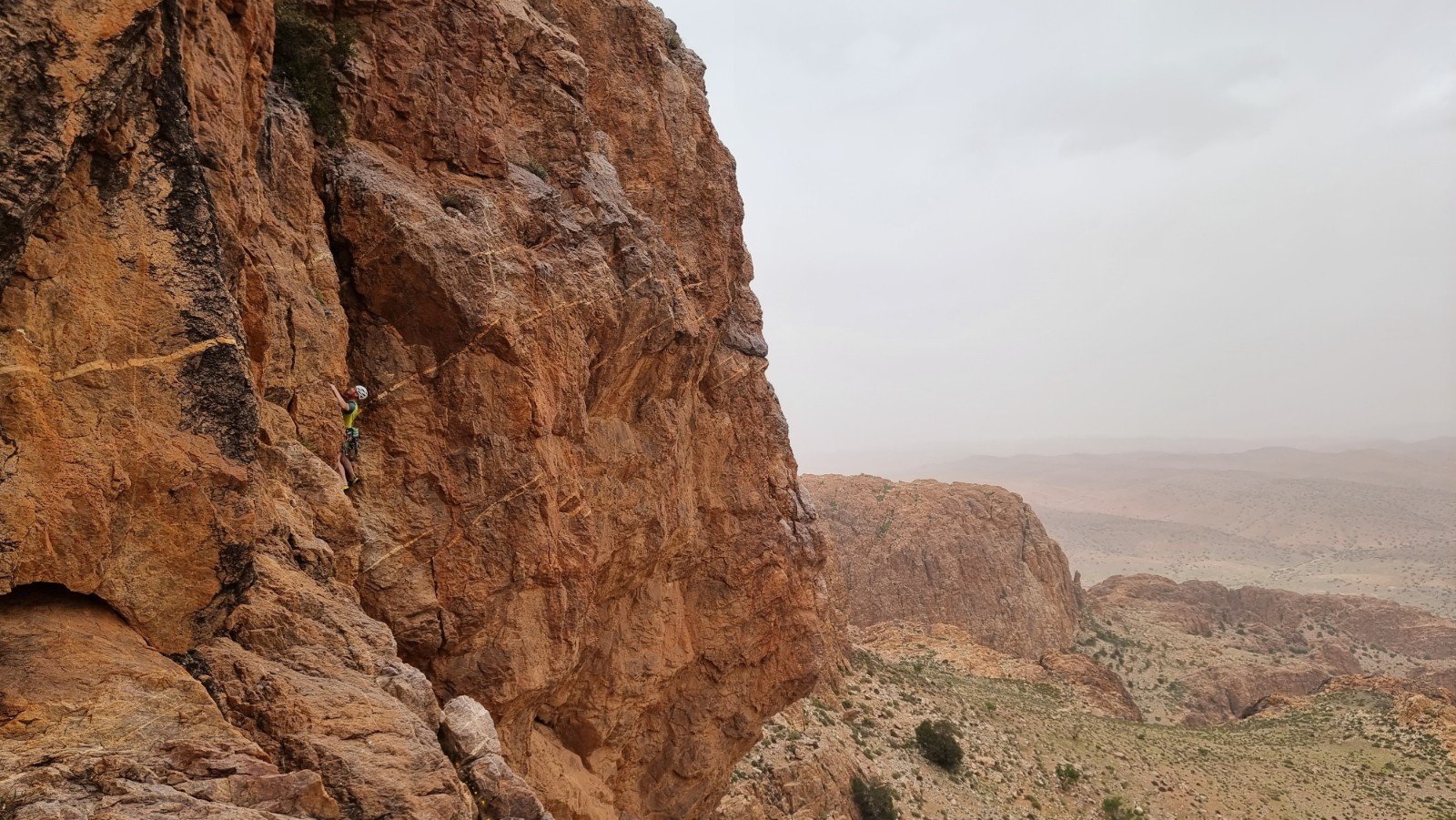
… and Graham on P4 of Aphrodite.
Heading down we explored the deserted village near the base of the crag.

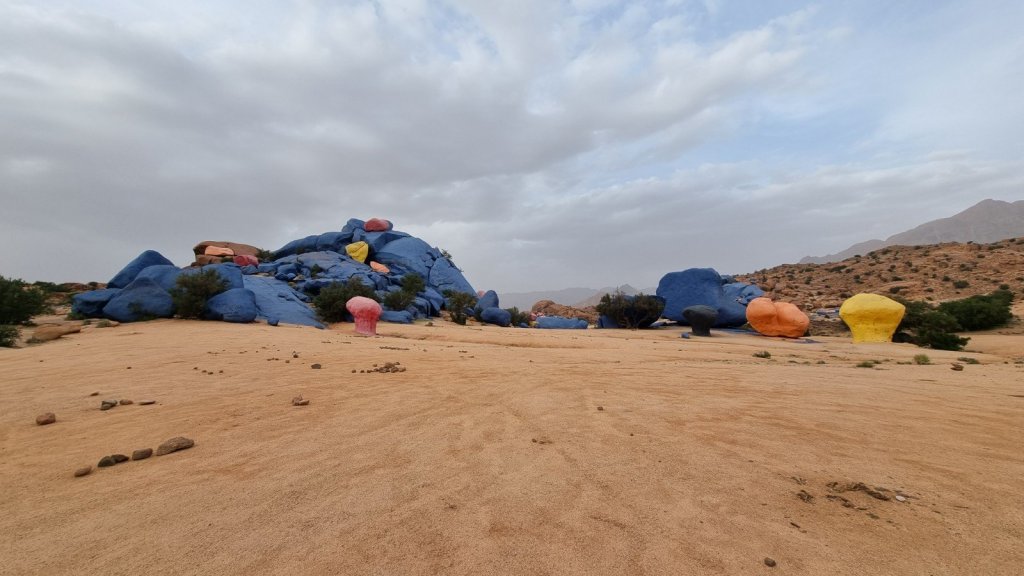
We were down in time for a side trip south of Tafraout to check out the famous “Painted Stones” – what had started out as an interesting art installation has now got somewhat out of hand!

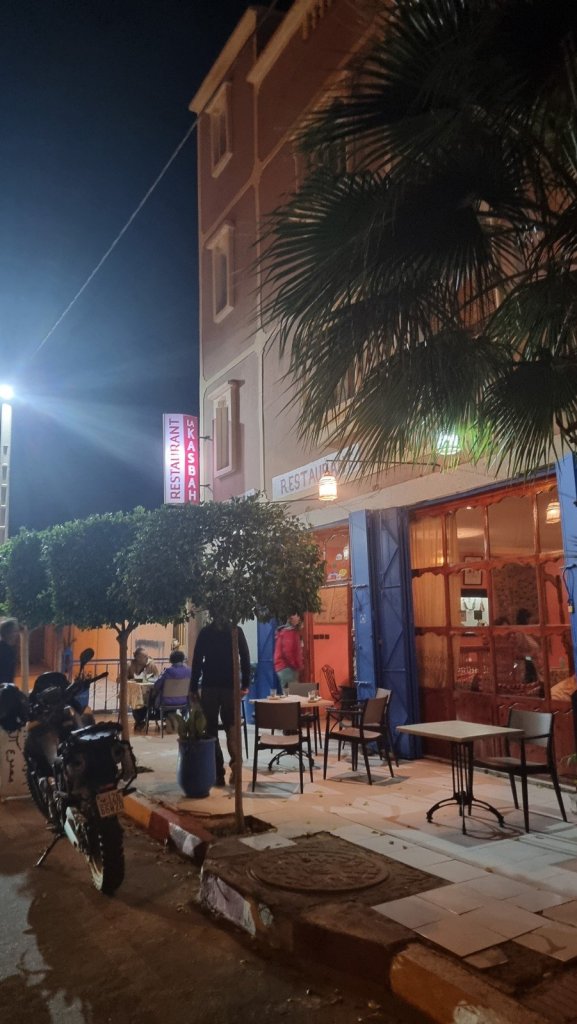
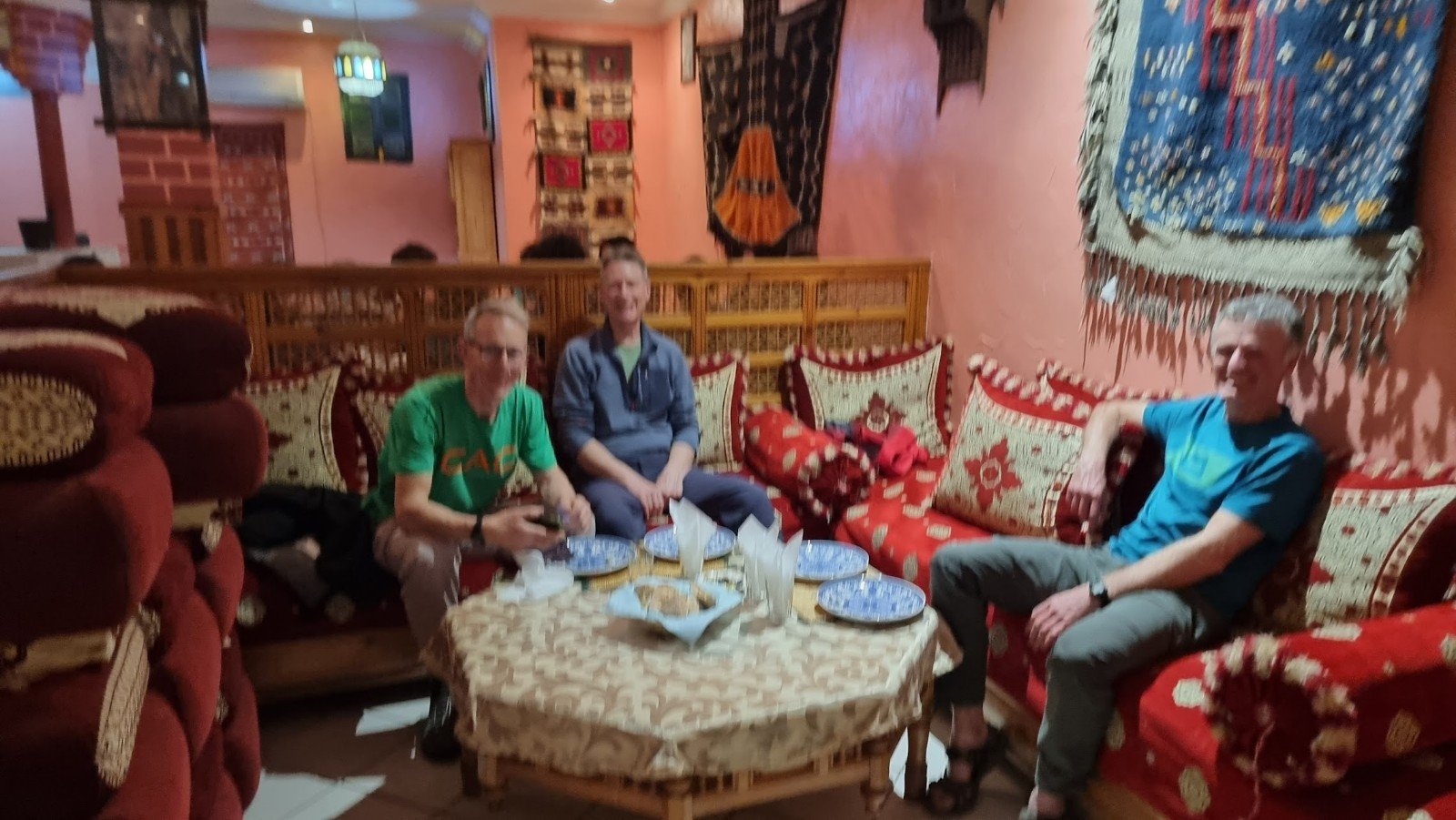
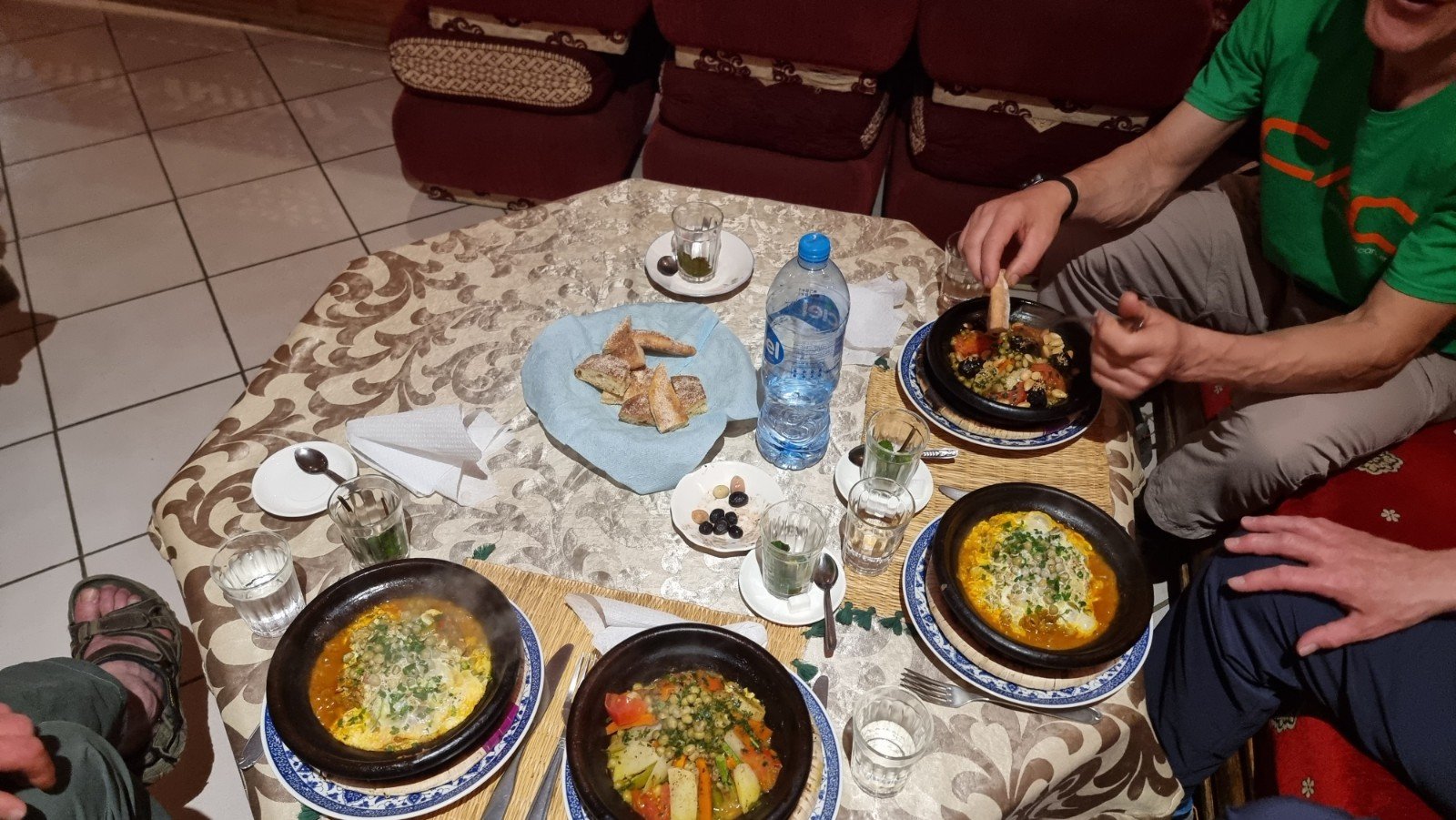
There are plenty of eating options in Tafraout, the biggest settlement for 100km (though that isn’t saying much!) but the Kasbah restaurant (not to be confused with the Kasbah Tizourgane – see the next post) came highly recommended and we’d thoroughly endorse that – we ended up eating there all three nights sampling different dishes from the 90 Dirham (about £7) 3-course menu, washed down with mint tea, and enjoying the great Berber hospitality of Mohamed and his staff.
Our base in Tafraout was Hotel Salama…
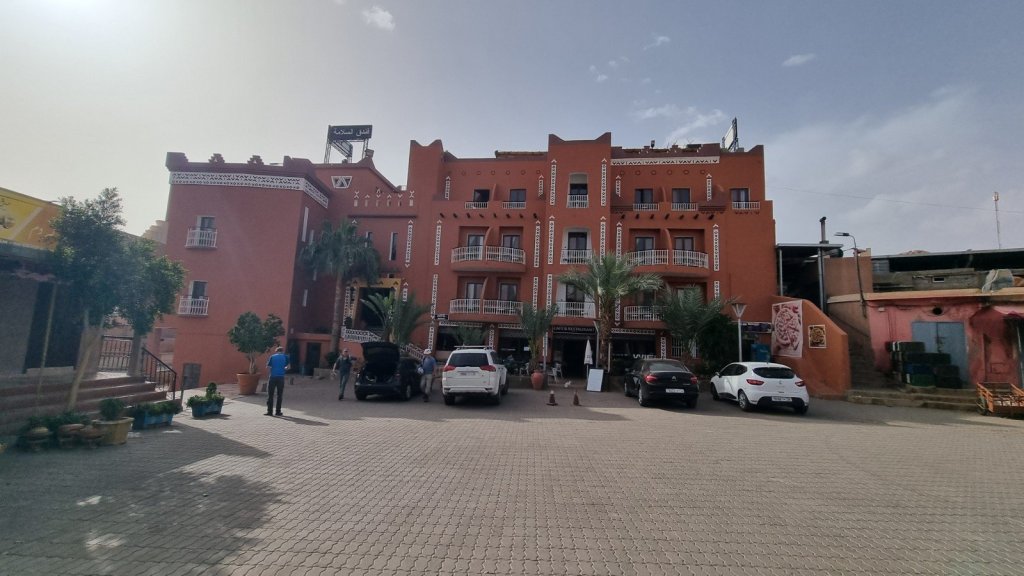
… which also comes very highly recommend – £30 gets you a clean and well maintained ensuite twin room with a balcony view over a bustling square to the huge south-facing walls of the Amelyn Valley crags:
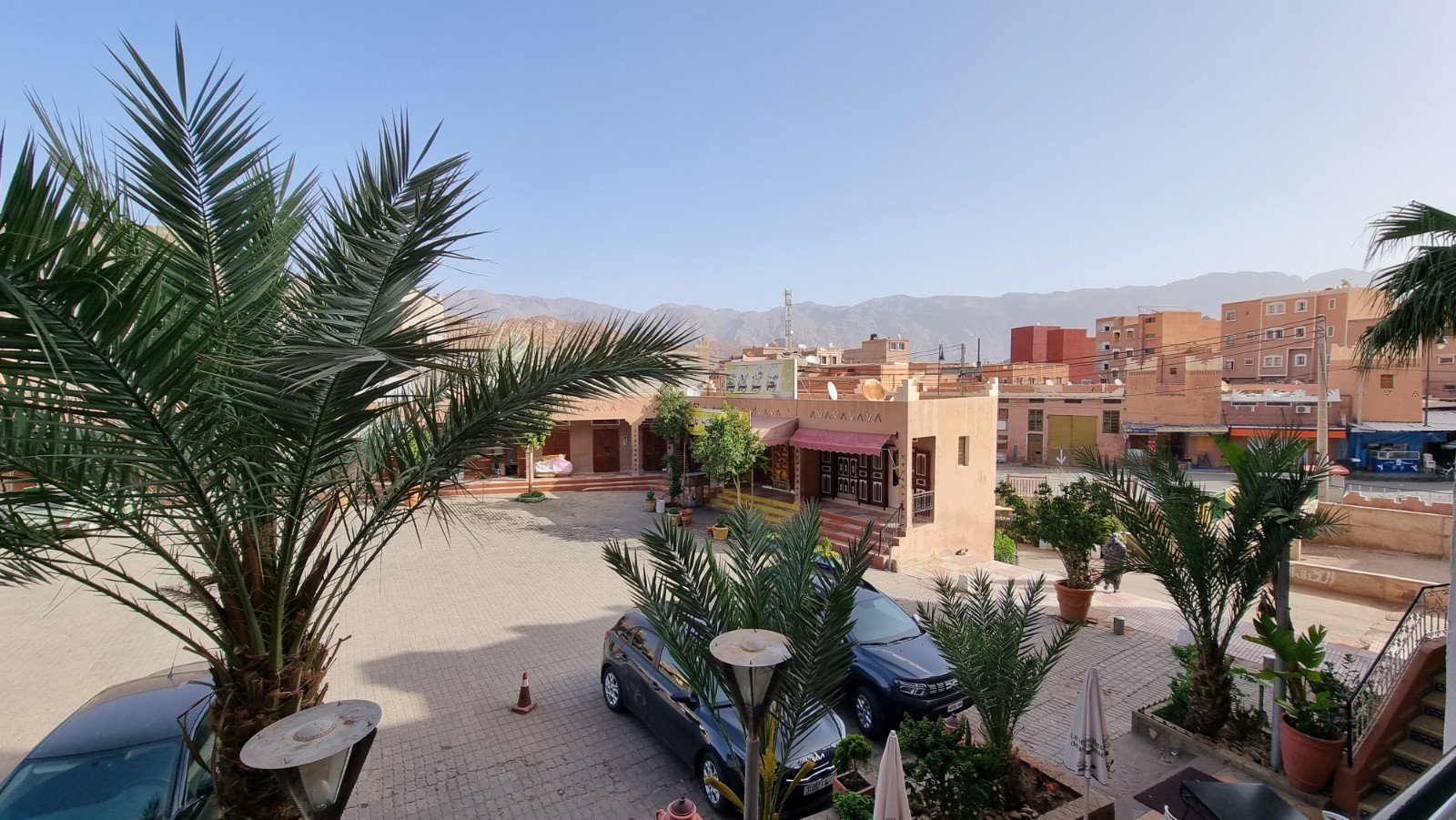
… dominated by the unmistakable (once you get your eye in) Tete de Lion.

Not much shade to be found there, but the spectacular Tizgut Gorge cuts into the main line of cliffs, offering east and west walls and the opportunity to chase the shade (or sun) as conditions dictate.

A note on the approach – there are a couple of paths shown in the guidebook and it’s worth seeking out the one that forks right, to join the gorge higher up, rather than dropping down to the watercourse earlier – it is clearly indicated on Open Streetmap. Another note is to read the small print – the advertised 30mins gets you to the entrance to the gorge, and it’s another 20mins to the Main Walls.
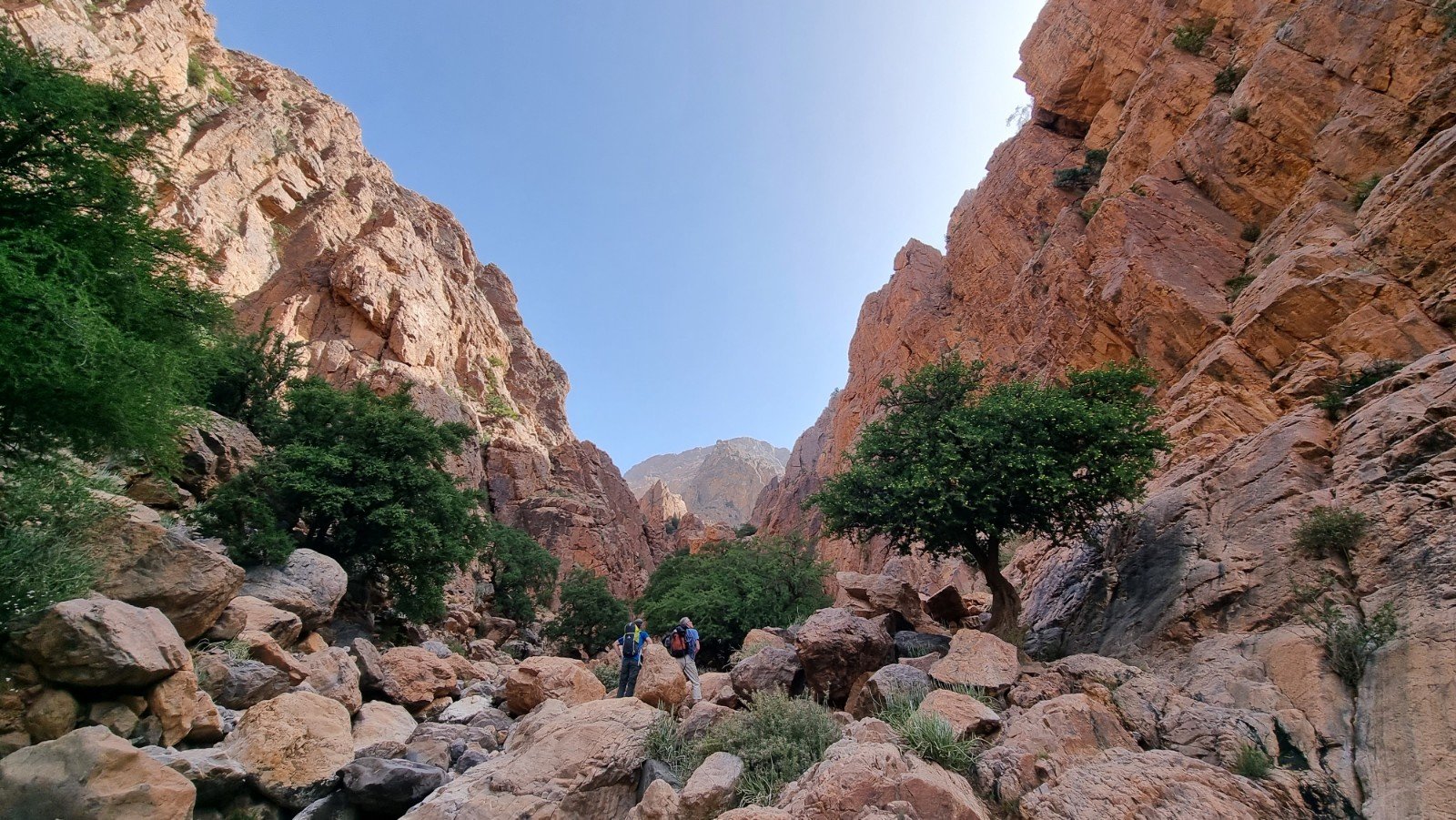
We headed up for the west-facing East Wall, hoping to take advantage of the morning shade. Here’s a shot of the centre of the East Wall taken after the sun came round. Tagine takes the awesome central crack and Tizgut Crack is the big corner on the right (still in the shade)

Andy and Graham bagged the plumb line of Tagine, E2 5c, 125m, so Paul and I opened our account with
Tizgut Arete, E1 5a, 125m (actually more like 90m).
This takes the striking righthand arete, though the guidebook description is pretty minimal, and the direct start indicated by the line of the topo proved unlikely on the rock, so entering from the left is more logical.
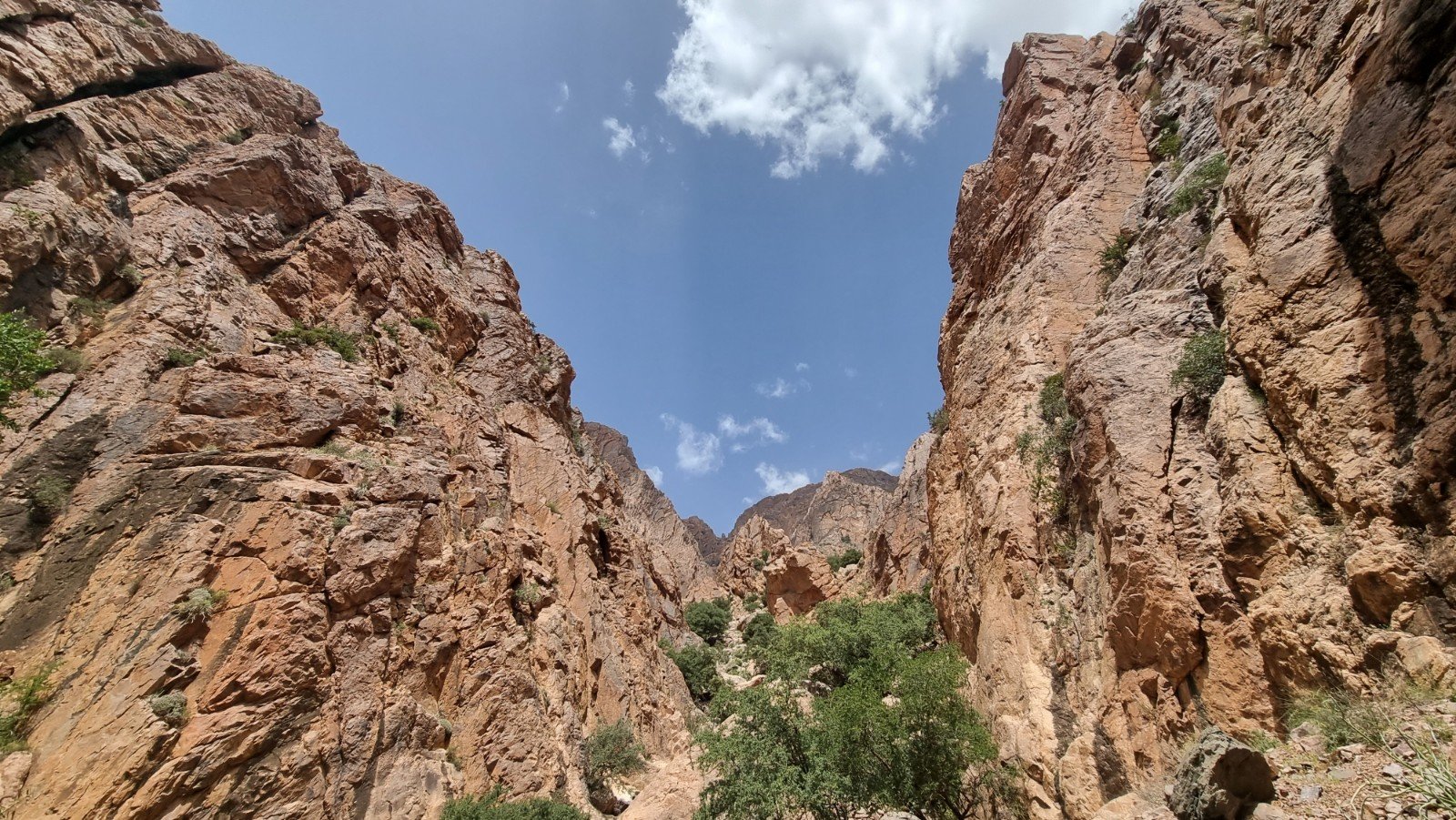

Beyond that you’re questing up slightly intimidating territory with spaced but reasonable gear – it all comes together in the end, and the grade seems fair. Here’s a view of the huge boulder at the base of the route (with a Berber-constructed stone staircase) from the top of which you can access the arete via a few steep pulls and a wander rightwards.
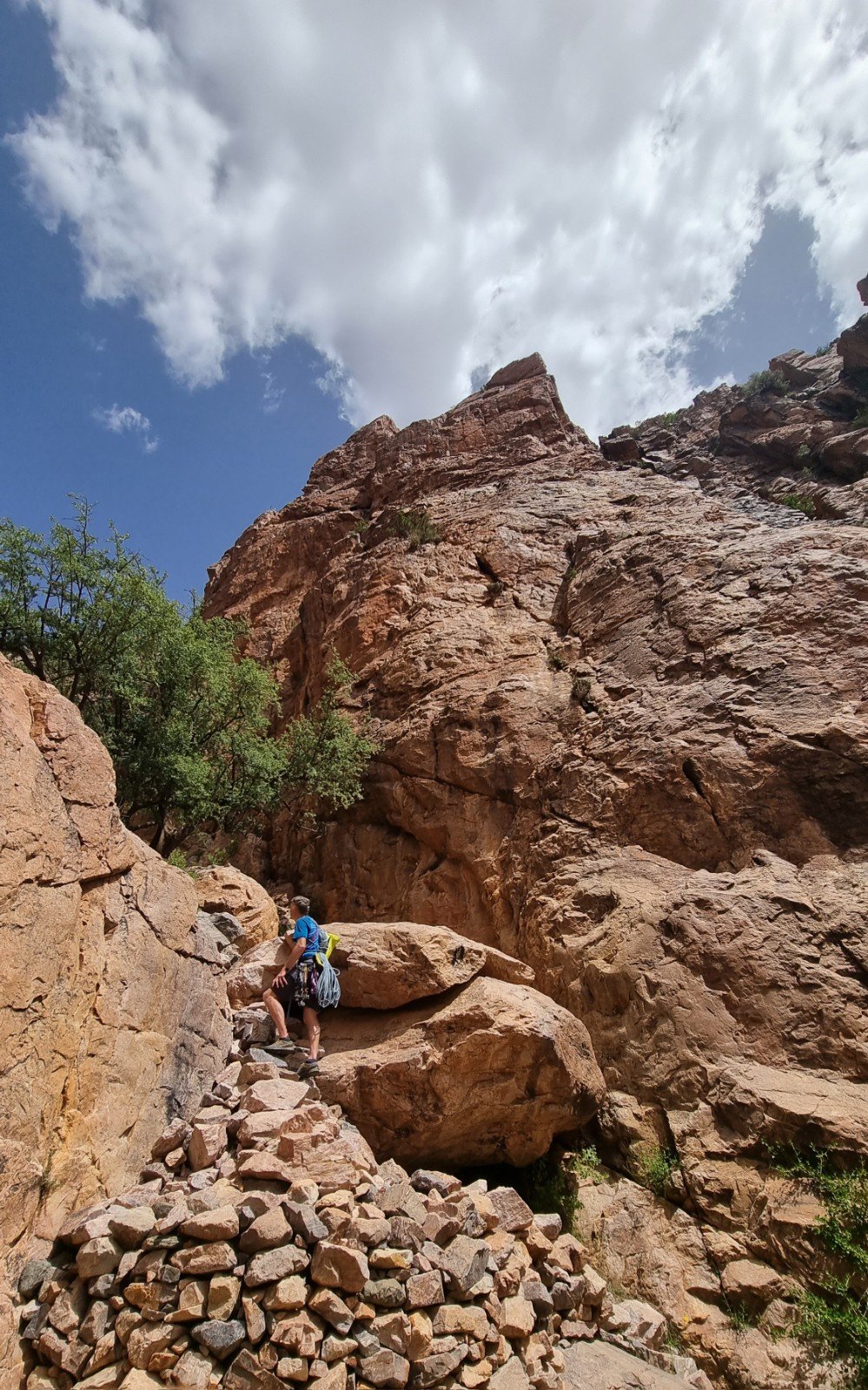
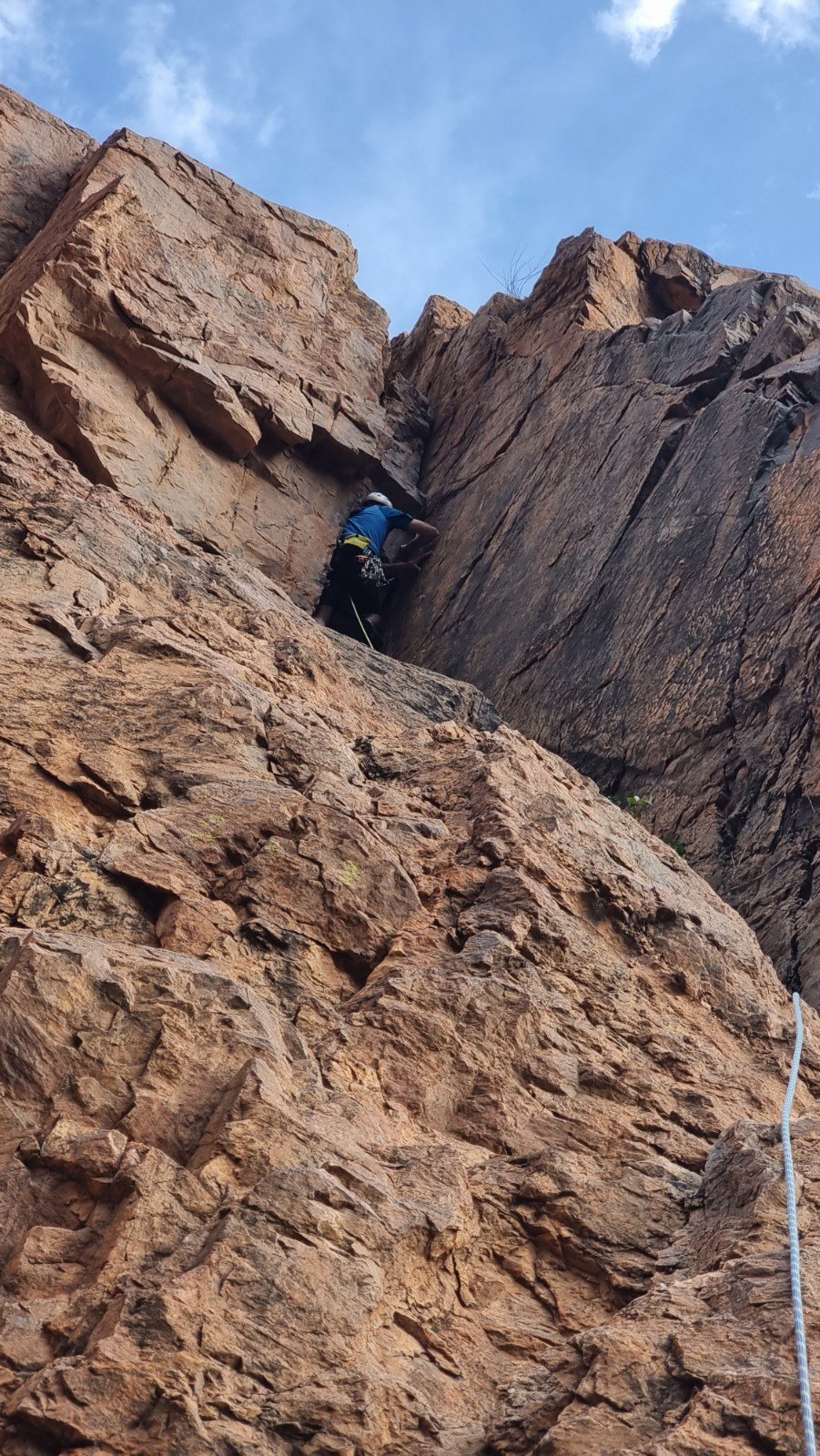
Back down to the floor of the gorge and the sun is now hitting the East Wall. We’ve got a choice of sweating our way up Tagine, climbing the Joe Brown classic Tizgut Crack (still enjoying shade but needing a couple of sizeable cams which weren’t part of our armoury) or waiting for the West Wall to come into the shade. We plump for Option 1 and are rewarded by a stunning route: technical climbing up to the roof which is overcome with some baggy jams and the judicious use of a shoulder.
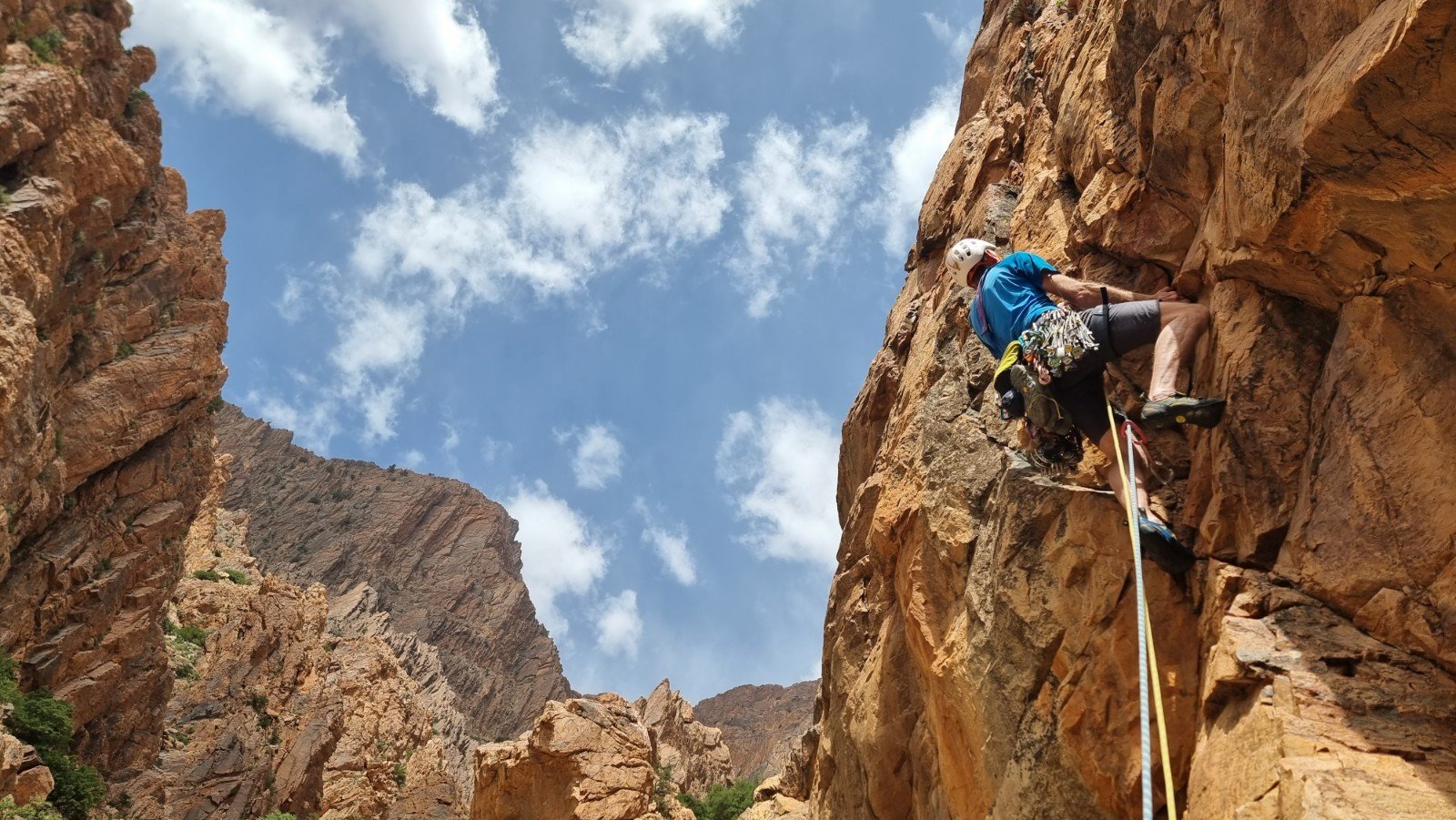
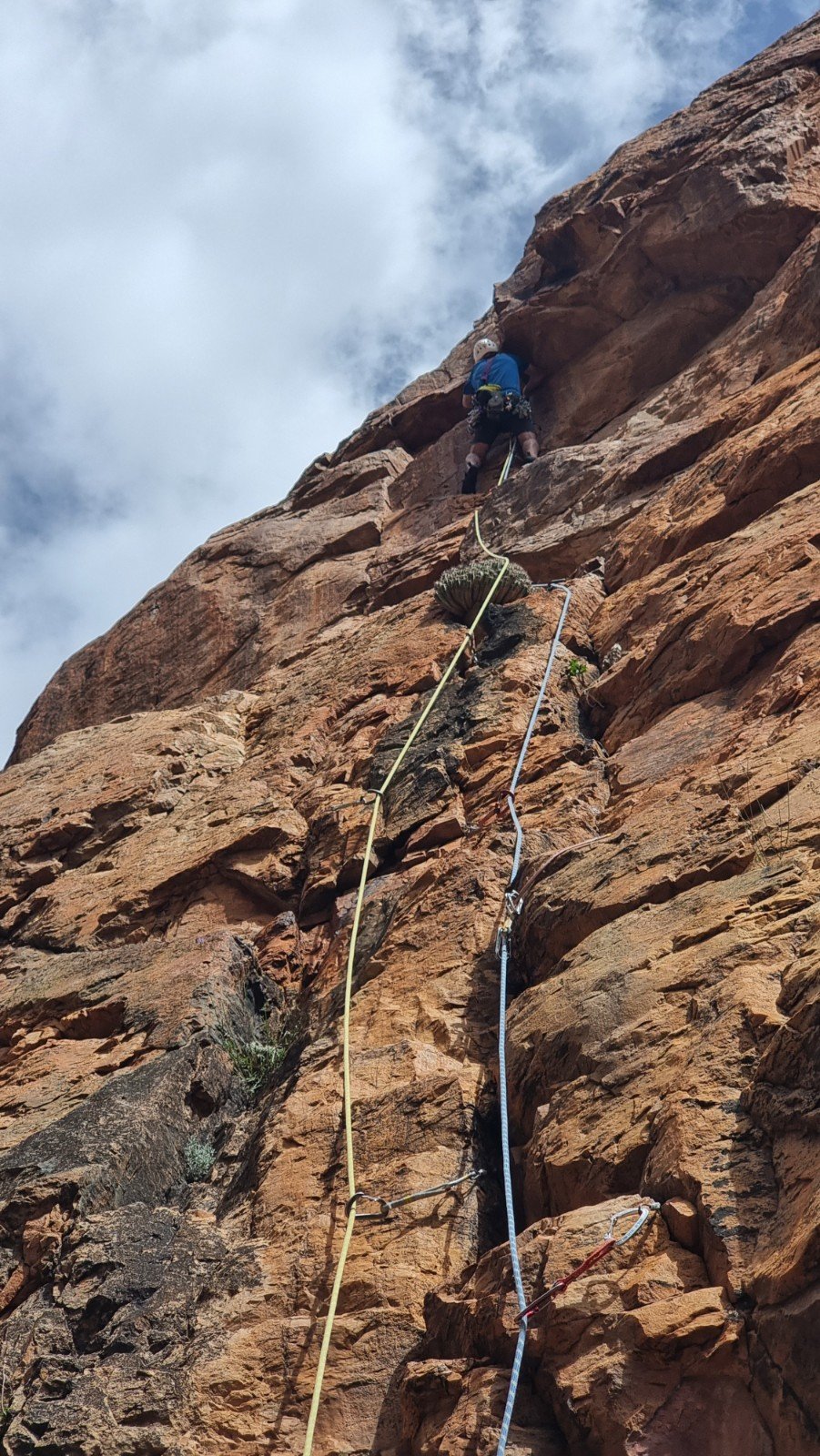
A stance in a “Sentry Box” around 35m seems sensible, leaving some more stiff corner cracks to reach a belay and possible rap point in another 20m or so, but that would miss the final groove and character-forming square-cut chimney. We thought top-end E2, 5c, 5b, 5a/b and 4*!
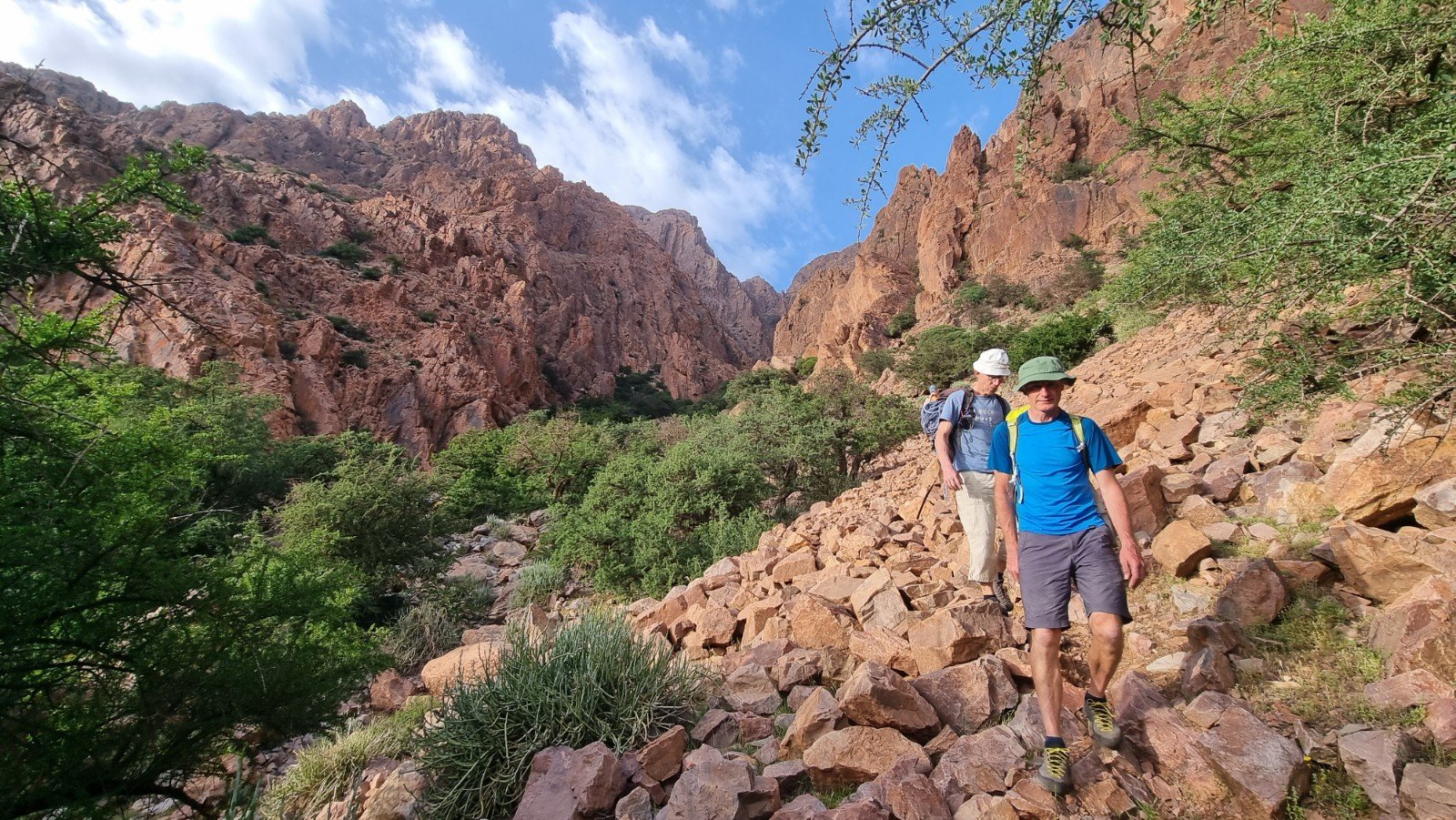
We only spotted the better upper path on the descent…
Back in Tafraout, we felt we’d earned a beer. Whilst alcohol is off limits across most of the country, the Hotel Les Amandiers has a licence and we enjoyed a welcome cold sundowner accompanied by commanding views over the Amelyn Valley and the mesmerising call to evening prayer echoing from the tanoys of the town’s mosques.
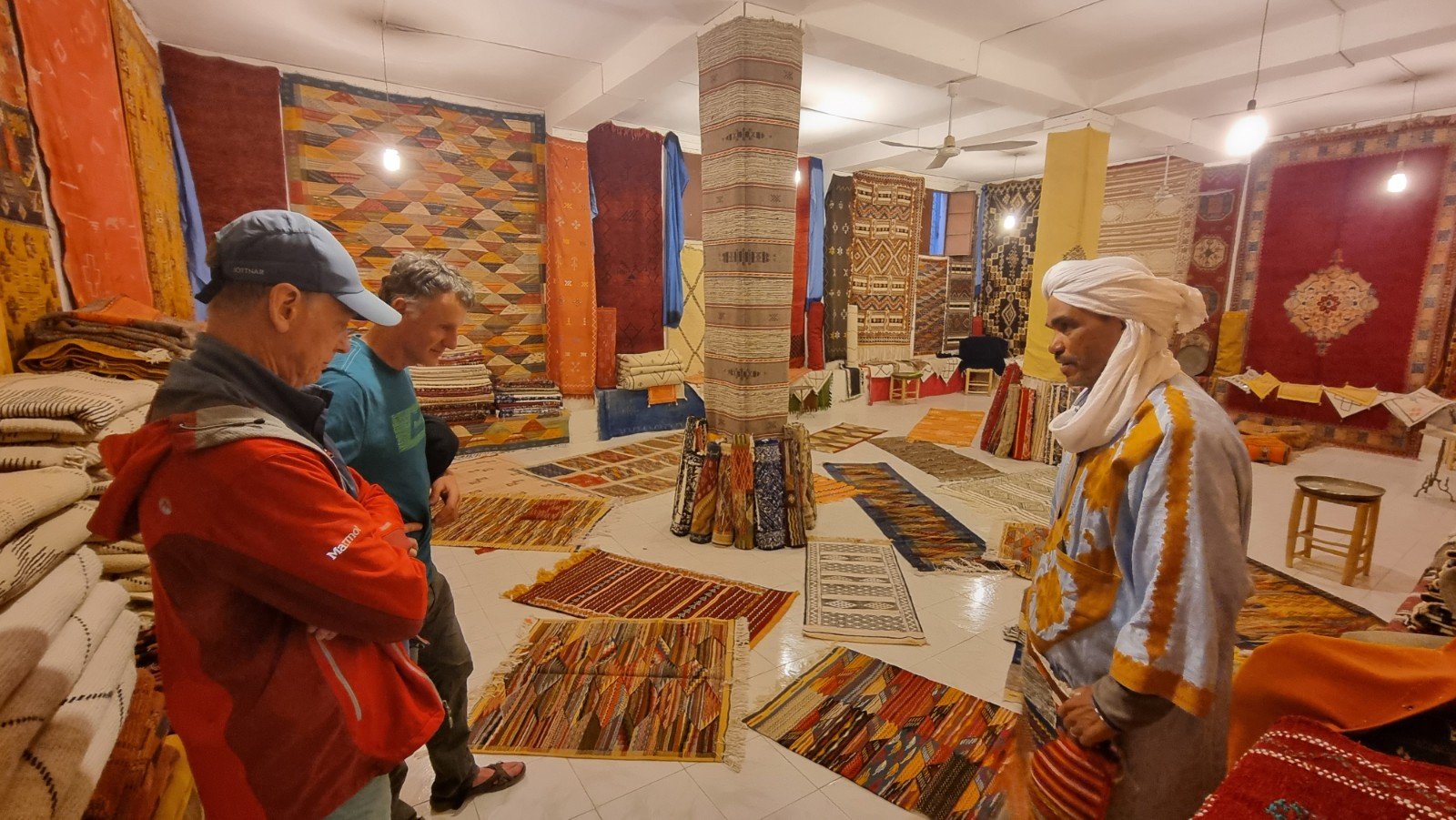
With more unbroken sunshine the next day we decided to head north, but not before a quick tour of the souk and a visit to Sahid’s carpet shop. This was pure theatre, as the proprietor put on a masterclass in the age-old art of salesmanship and bartering – utterly charming and doggedly persistent. The carpets were very fine pieces of workmanship (or that should be work-woman-ship)…
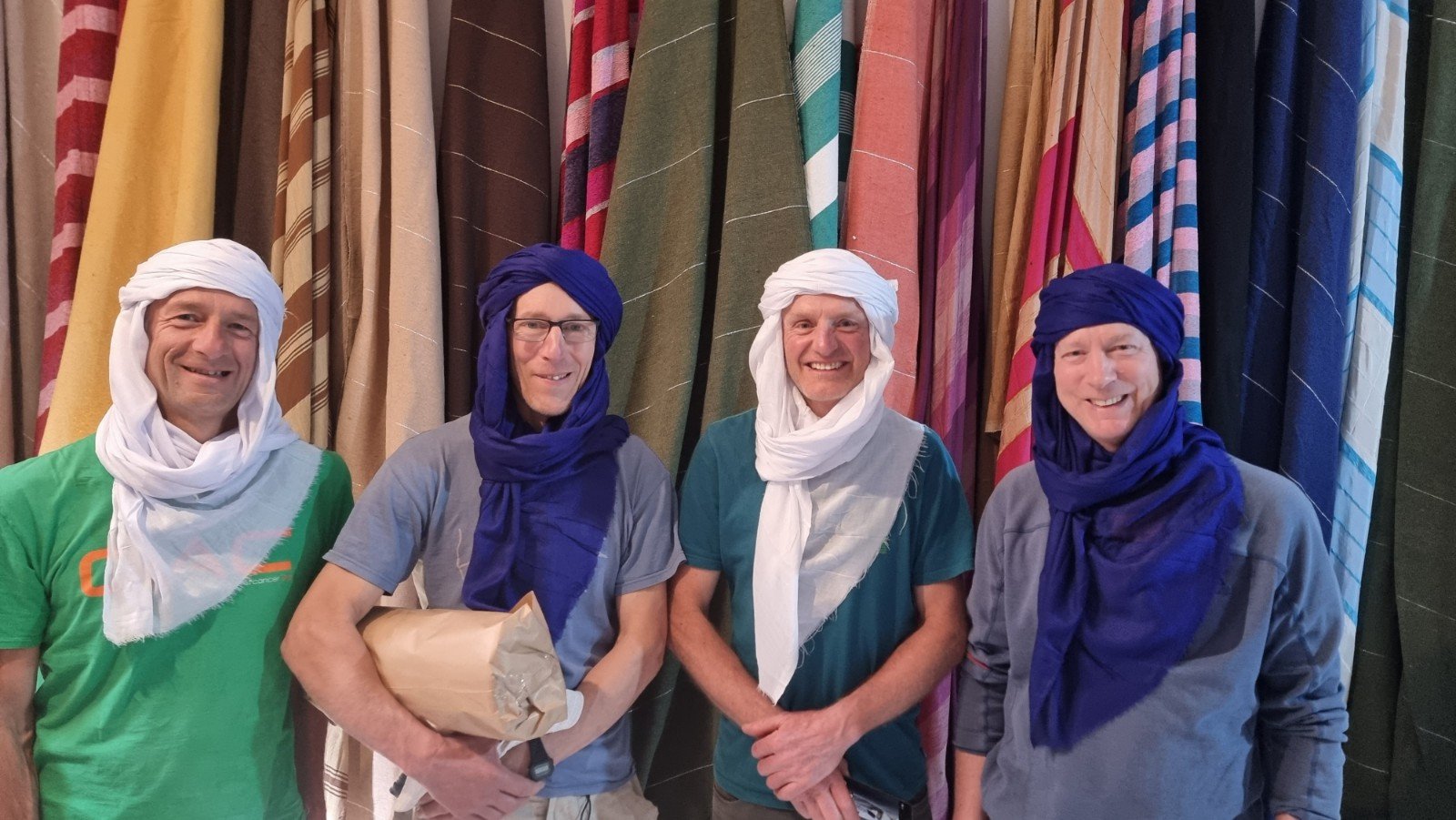
… and we were even dressed in turbans for a memorable team photo. A great memento of our flying visit to Tafraout – we’re sure to return (perhaps in the cooler months to enjoy the sunny aspect of the majority of the crags).
 RockAroundTheWorld