
Our third Pyreneean objective from Parois de Légende took us back over the French border, and north west into Vallée d’Aspe, which is the next valley west of the Ossau Valley where our trip had started. The Ossau, Ordesa and Aspe are only separated by a few tens of kilometers, but they vary hugely in their geology and ambience.

Vallée d’Aspe is the most tucked away, accessed by tiny winding roads, and you park your car a couple of km up a steep dirt track at Pont Lamary (not signposted and a bit unlikely looking, but navigable in a Fiat 500. There’s parking when you get there – here’s a Google pin) https://maps.app.goo.gl/qoVupgurUzHx1xQt7
From here, it’s an hour’s walk to the three shepherd huts of Cabane d’Ansabère https://maps.app.goo.gl/1nbuY19mTraKbBZr7
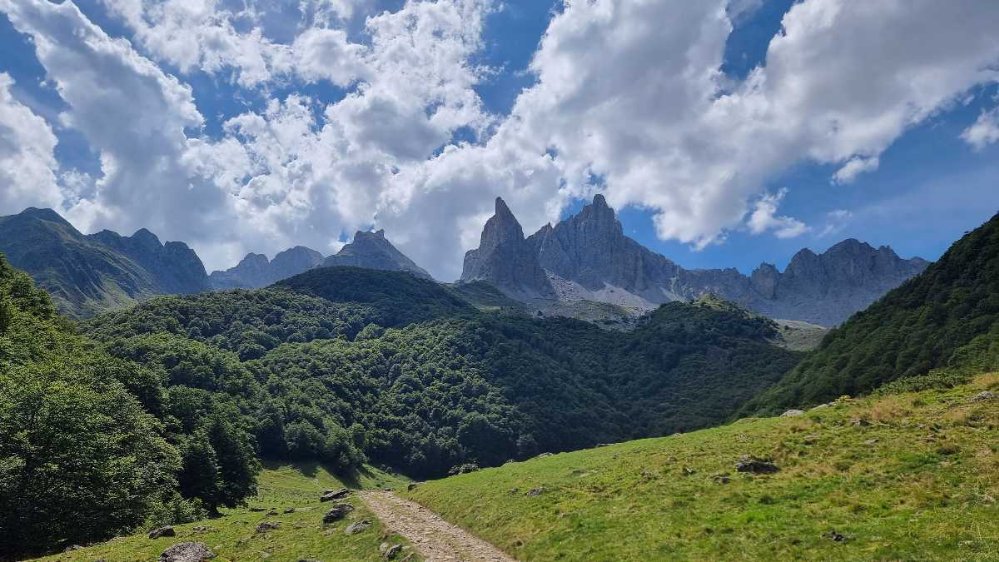
Early glimpses of the Aiguilles d’Ansabère…
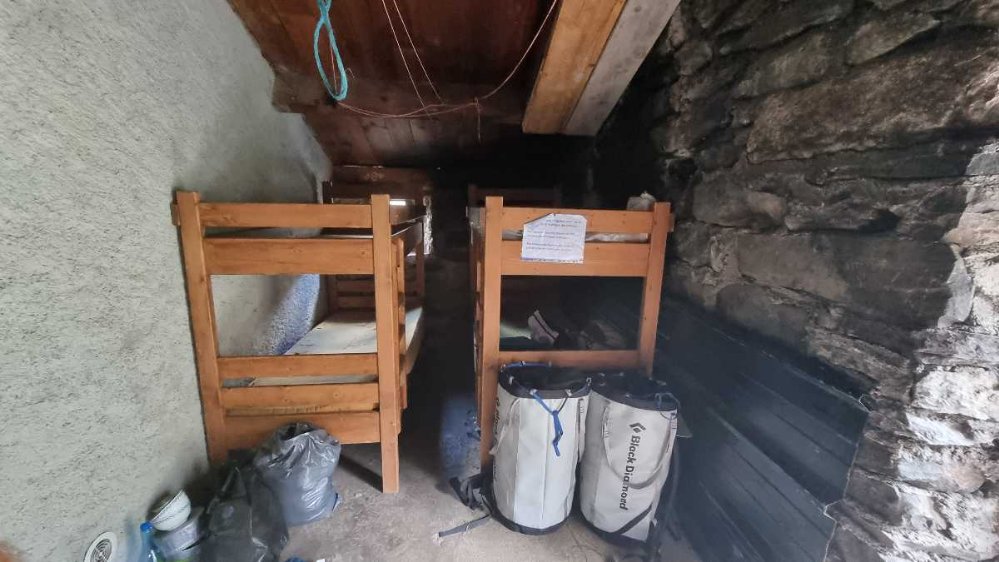
One of the huts is set up as a fairly comfortable bothy – free to use and even centrally heated as it also houses a generator.
But far more appealing to bivvy outside (though Bill did retreat indoors from his bivvy bag when it started to rain in the night amidst a flashing lights show).

No “Excellent Adventures” bivvy is complete without a beer…

… and a pot noodle (though we had to improvise on utensils!)

Last view of the Aiguilles for the evening, as the cloud inversion came rolling up the valley to coincide with the sheep coming meandering down the hillside for the night.
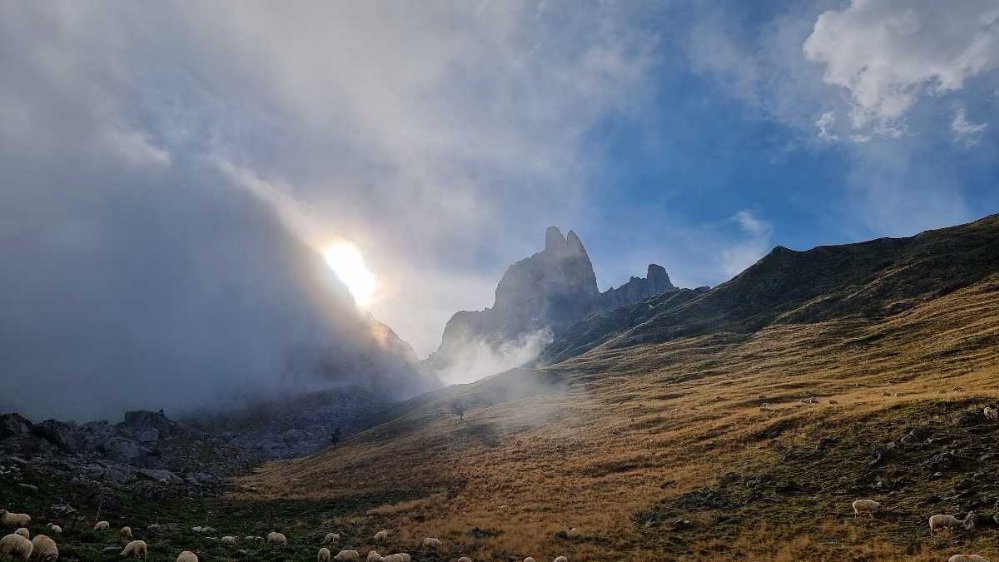
Next morning the cloud is still enveloping the bivvy, but we soon punch through into clear skies as we head up to the Aiguilles. You just follow the waymarked (yellow flashes) path up towards the coll, before breaking out right for the final 10mins slog up scree. Just under an hour to the gearing up spot (you can leave sacks as you turn off the main path as you’ll be coming back past here on the descent).
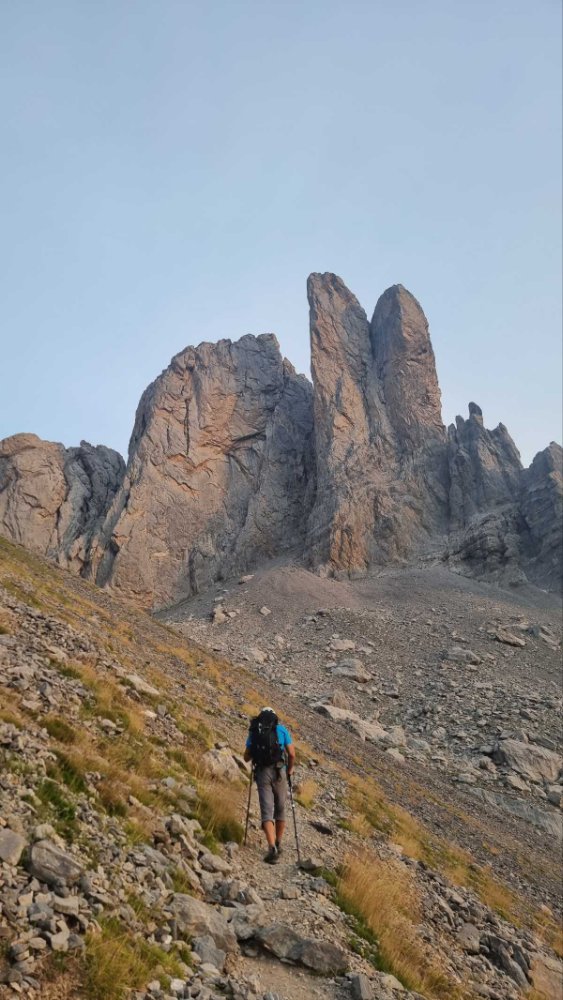
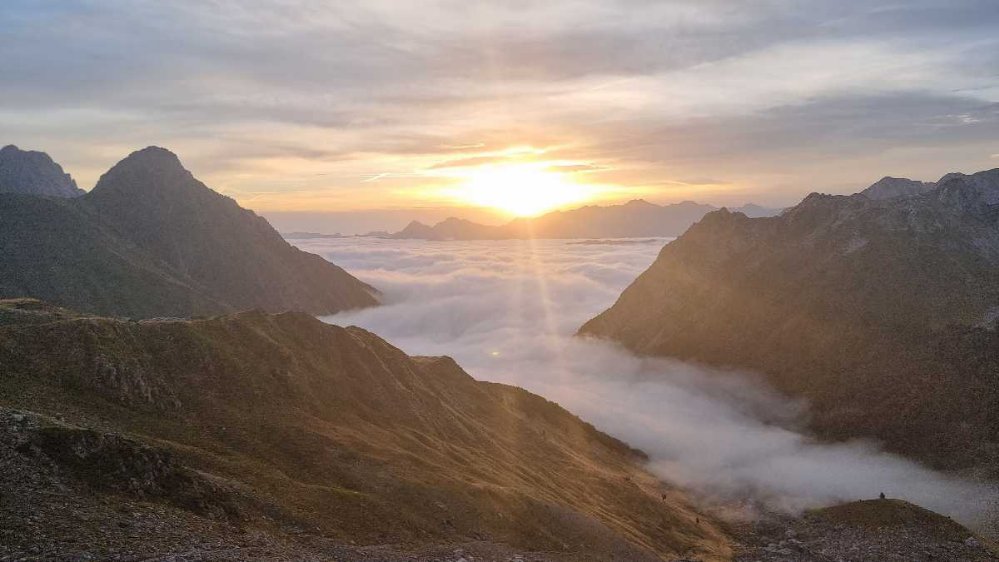
Stunning sunrise…
There’s a comprehensive write up here which gives some pitch-by-pitch descriptions: https://steepground.blogspot.com/2022/06/spigolo-petit-aiguille-dansabere.html?m=1
The first pitch takes easy cracks in decent rock past a couple of bolts for navigation, before it all gets a bit rambling and crumbly for a while.
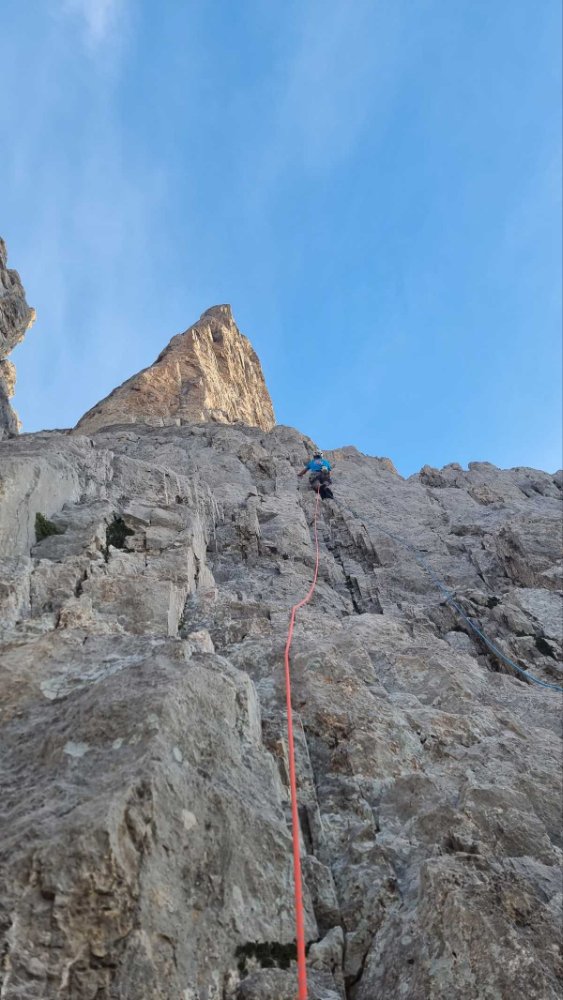
After 40m or so, keep an eye out to your left for a 3-bolt belay (two ancient, one merely old).
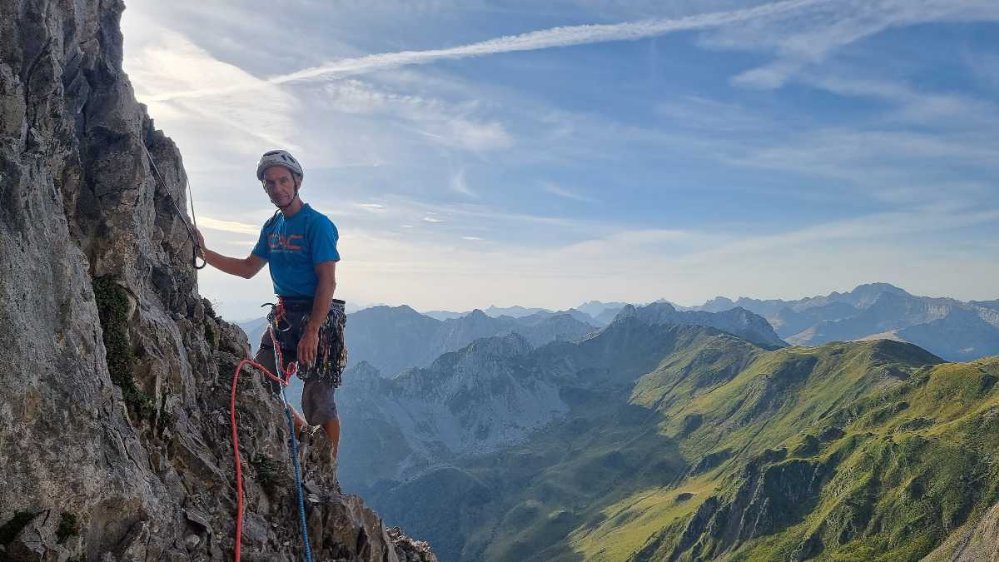
From here a chossy ramp leads up rightwards into the huge corner system that splits the south face. DON’T follow this for more than a few metres (as we did!) but instead look up the steep white wall above and you should spot a bolt at around 10m and a peg a bit further up. These lead you with increasing exposure onto the arete, then up to a ageing belay which you ignore to go a few metres higher to stop at a magnificent ledge with numerous shiny bolts and a fearsome corner heading on upwards. Congratulations, you’ve arrived at the meat of the route!
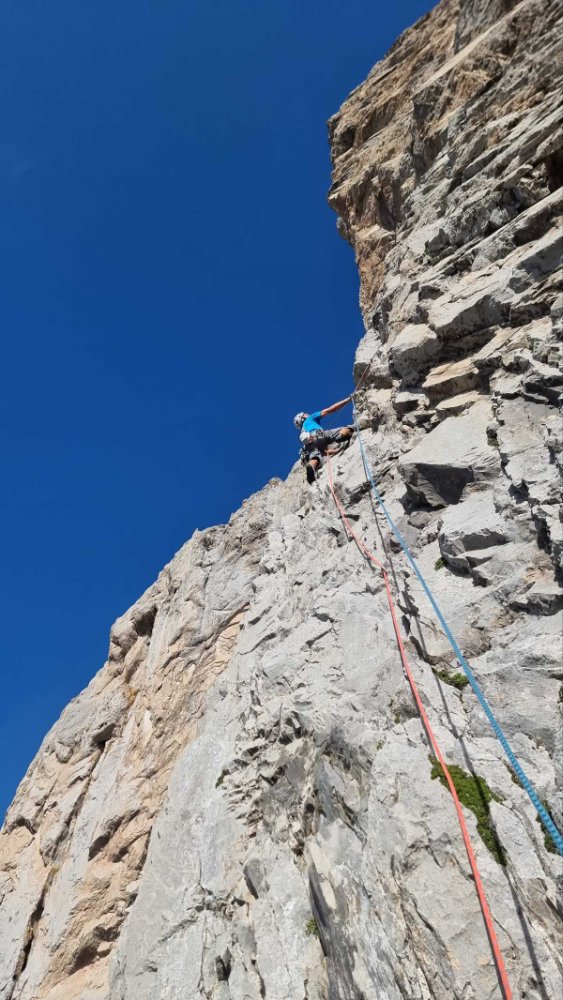
The 6c grade for the next pitch is a bit of a sandbag, and you’ll need a bit of jiggery pokery if you want some assistance as there isn’t much fixed gear.
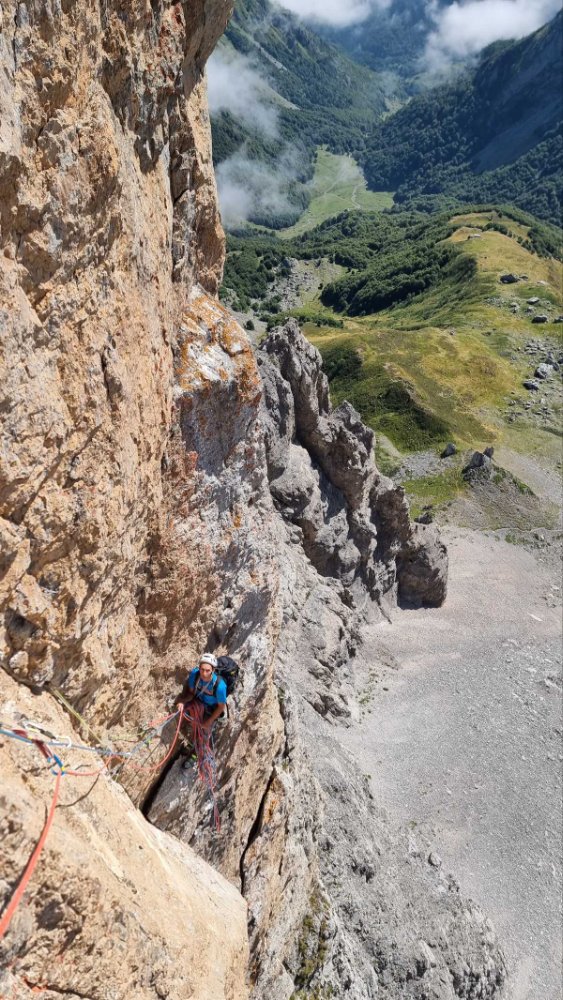
The subsequent 6b pitch is no pushover either, and meanwhile the exposure mounts as you climb the gently overhanging territory of the arete itself, with the Cabane d’Ansabère getting ever more distant below.


Pitches 5 and 6 are 7a+/7b and tough at that, though they’re equipped as bolt ladders so you can cover most of the ground as A0 with a few stiff pulls still required.
This brings you to an exposed eyrie and vertigo-inducing vistas downwards.

P7 is a short, airy traverse leftwards, and you start to sense success is within reach, with just three pitches which are “only” 6b+, 6c and V+.

You’d be wrong! The 40m 6b+ pitch feels E3 or maybe E4, WITH a handful of SP-AAAA-CED bolts, and a fair bit of ingenuity required to supplement them, including the odd comedy (in hindsight) rusty relic…
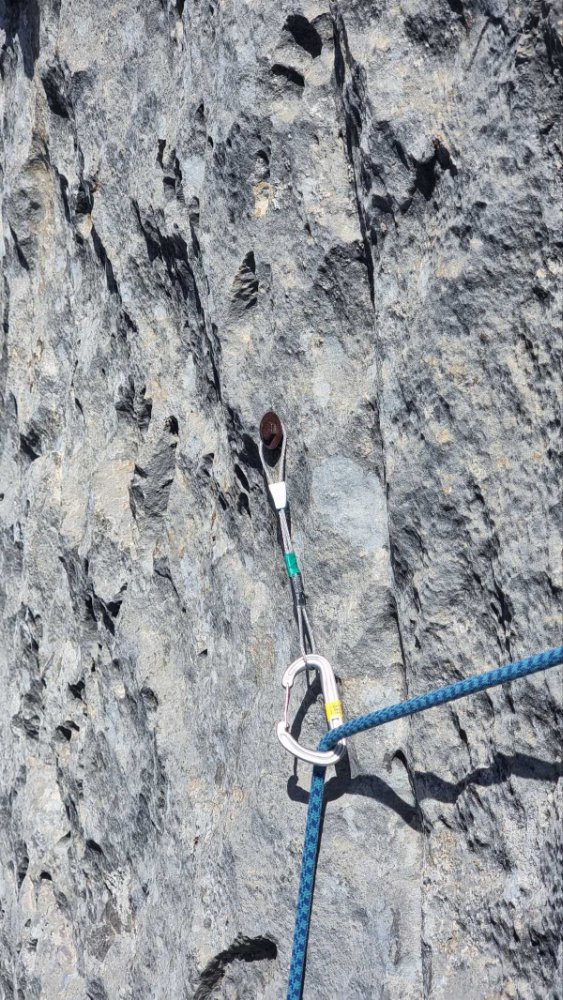
There are good holds to be had, if you keep the faith, and the rock is exemplary. An absolute belter of a pitch!
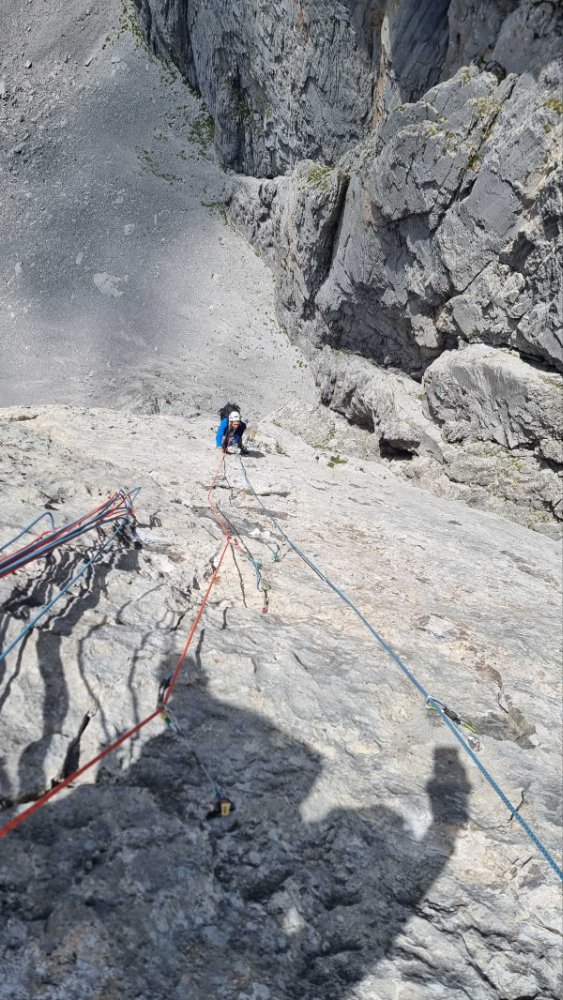
For the final blast for the summit you’ve got a couple of choices, but the 6c direct finish comes highly recommended by a couple of bloggers, and the bolts looked much newer, if still spaced. Here’s Bill nearing the top with the ridge below and immediately behind him being the one you eventually traverse to get off the Aiguille.
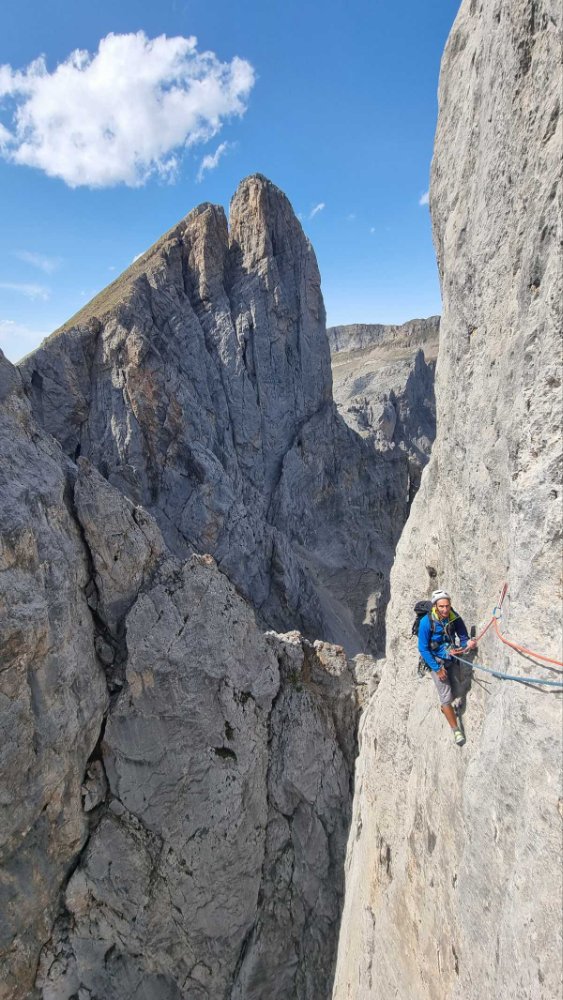
More bonkers exposure from the penultimate stance
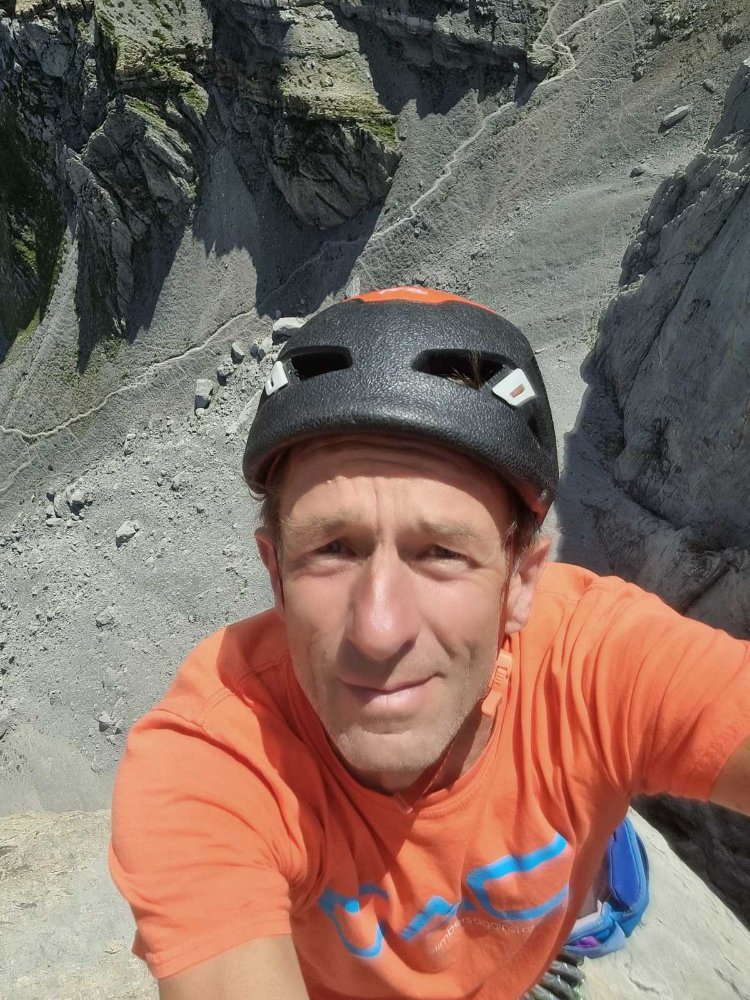
… and even the V+ final pitch offers a sting in the tail, with only a couple of bolts in 30m, the first one at 10m way above some fairly tricky ground.
Finally you top out and there’s an incentive not to linger as the seemingly inevitable afternoon cloud inversion threatens to engulf the descent.
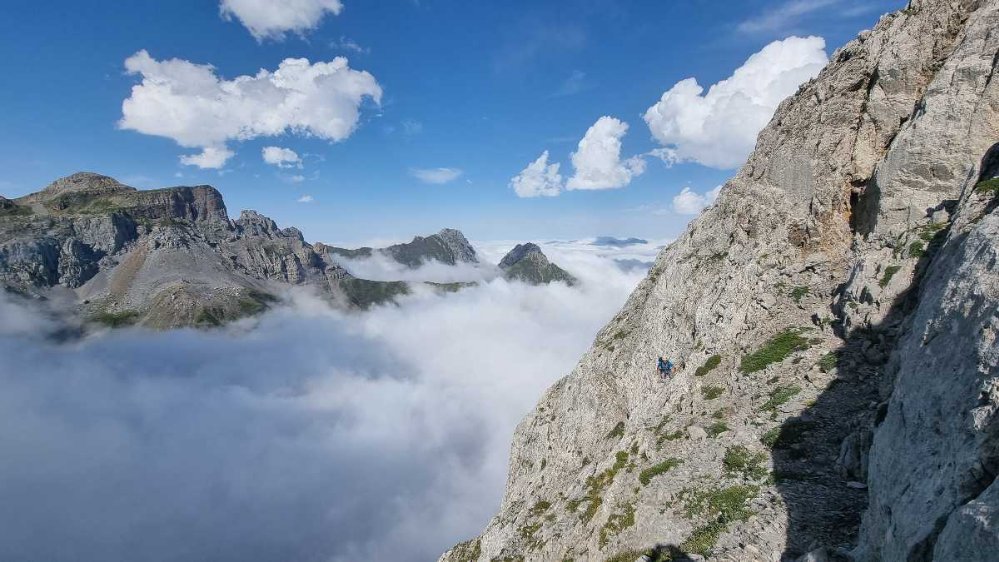
A couple of raps down the back…

… lead to some exposed scrambling and a ridge traverse, then more scrambling horizontally (skiers left) passing the occasional cairn to reach a rotten chimney system. Climb UP this (the guys who wrote the blog post referenced above went down here by mistake into a 4-hour world of misery) and you’re soon traversing easy ground to pick up the main way-marked path to the col and to rejoin the approach path, with stunning “did we really just climb up there” views of the route.
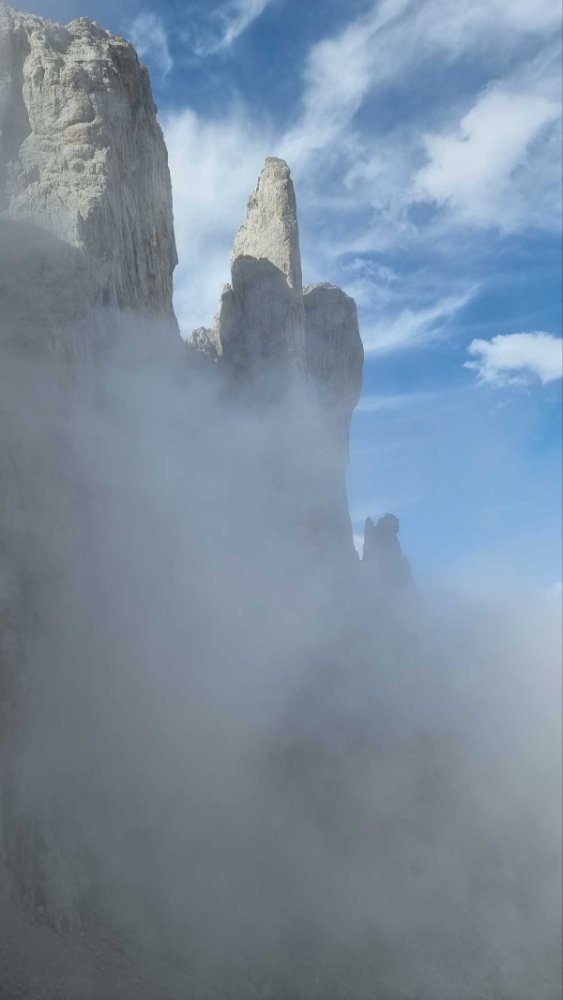
Here’s a best guess of the line of the route
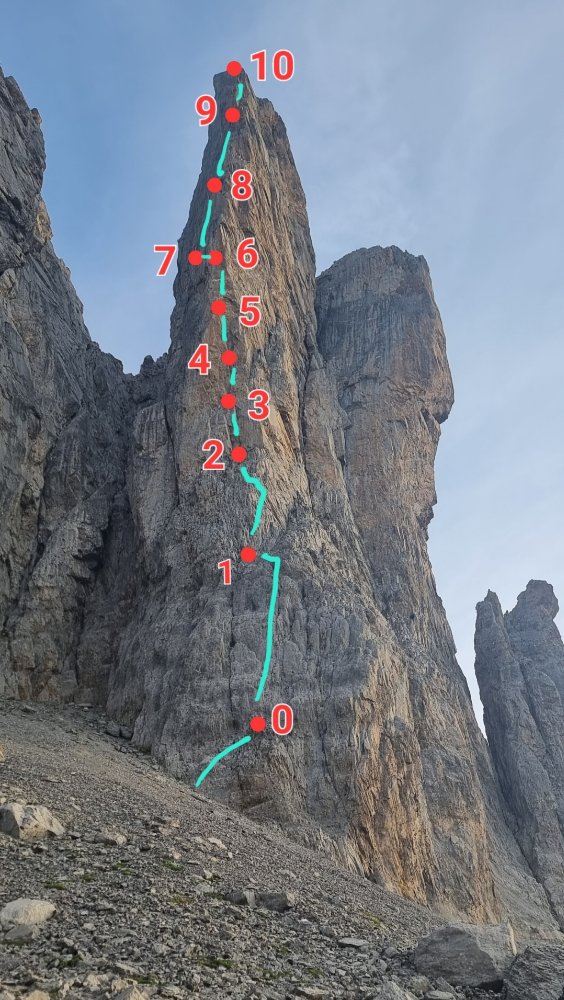
Petite aiguille d’Ansabère, South Spigolo, ED inf, 310 m, 10 pitches, 7b, 6a obligatory (concensus would suggest more like 6b/+ obligatory!)
Top tip: if you’re looking for somewhere as a base nearby, the refuge at Centre de l’Abérouat is a really welcoming spot, with good value food and bunkhouse accommodation, about 40mins drive from the parking for the approach https://maps.app.goo.gl/3sqjNZGiq9Smf4i5A
Another fabulous route (PdeL hasn’t let me down yet!) bringing up around 1,200m of ED climbing in five days and marking the end of our brief blitz of the Pyrenees. Next stop: Picos de Europa.
 RockAroundTheWorld