
When it comes to profile, Portugal is the ‘poor neighbour’ of the Iberian Peninsula. This certainly isn’t for a lack of fabulous climbing, or a stunning backdrop to enjoy it against, it just simply isn’t ‘on the map’ of most British (or indeed European) climbers. If I review the ‘page hits’ on RockAroundTheWorld, the number of searches for information about Portugal is proportionally way more than other areas we’ve covered – not because of its popularity, but simply due to the dearth of information available elsewhere on the web compared with the ‘honeypot’ areas. Here’s my effort to help correct the situation!
This is also an attempt to make ‘RockAroundTheWorld’ a more useful resource for the climbing community by adding the occasional ‘Destination Guide’ to help to inspire and plan a trip, and a searchable map so you can see how it all hooks together. YOU CAN ALSO FIND THE SEARCHABLE MAP ON THE MAIN MENU BAR ON THE FRONT PAGE OF THE BLOG: CRAG FINDER. This is a pilot for both, and I’d welcome your feedback (in the ‘comments’ section below or via email to dominic@rockaroundtheworld.co.uk ). Hopefully it’s interesting / useful, and a bit of a silver lining for the fact that I’m currently nursing a couple of broken ribs after a tumble off T-Rex.
Overview: Portugal has a huge amount to offer the visiting climber. With a range of landscapes, altitudes and climates, from mountain adventures, to inland bouldering and seacliff cragging, there’s something for everyone. This variety is matched by the diversity in rock types, with limestone predominating in the south and around the coast, a spine of granite through the heart of the country, and a smattering of quartzite, sandstone, basalt, and other volcanic rock, each with their own climbing characteristics. There’s also a mix of sport and trad to throw a bit of spice into the blend. If there’s one factor that underpins much of the climbing in Portugal, and differentiates it from it’s bigger neighbour Spain, it’s the sea. You are rarely far from the immensity of the Atlantic (quite often within spraying distance!) and it makes it’s presence felt with a constant thundering. As a life-long seacliff fan I may be biased, but there’s nowhere else in the world that comes closer to matching Britain for the wealth of seacliffs and the climbing tradition to match.
This piece is written based on a couple of months spent in Portugal, on two separate trips both during Jan/Feb a couple of years apart, visiting around 30 crags across the country. Inevitably it is constrained through that lens, so can only offer a partial view, but hopefully gives some useful perspectives. I’ve split the review into chunks based on the main centres of gravity of climbing in the country, with a few comments about the possible ‘base camps’ that you might chose, but somewhat focussed on the #vanlife (though I’m sure you could plan a great fly-drive trip or airbnb tour).
The South – Rocha da Pena and Sagres – The Algarve might be more famous for beaches and golf courses, but it also contains a fair amount of climbing. ROCHA DA PEÑA is perhaps the Portuguese venue that most resembles a typical ‘eurocrag’ with well-bolted steep orange limestone spread along an escarpment, accessed via a fairly short, flat walk. There’s even a bar at the parking. It would probably only merit 4* on the 6* Donde Escalade scale, but that’s still more than I’d give any mid-grade sports crag in the UK, and it’s a great entry point (literally and figuratively) to climbing in the country. Much of the rest of the climbing in the south is concentrated around the seaside town of Sagres, on the most south-westerly tip of Europe. The contrast couldn’t be greater, with the booming Atlantic surrounding you on three sides, and the noise a constant soundtrack to proceedings. There’s plenty of full-on ‘rap-in and get your toes wet’ seacliff climbing, like PONTA DE BALEEIRA and THE MIRROR but also plenty that you can access on foot, with less commitment like FOZ DOS FORNOS. It bears more than a passing similarity to Pembroke, and there’s no higher praise than that. There are a couple of very decent campsites in the vicinity of Sagres, including Camping Orbitur. Rocha da Pena is trickier, but a polite word and a modest purchase usually enables a trouble-free night parked up outside the Bar das Grutas.


South of Lisbon – Arrabida: Lisbon is blessed with enough climbing nearby to occupy two chunks, separated by the city and its magnificent natural harbour, which would make the commute between them a bit awkward. To the south, the Parque Natural da Arrabida occupies much of the coastline from Setubal to Sesimbra, containing almost a dozen crags in around 20km of coastline. The Forte do Cavalo Campsite makes a great base, within walking distance of the seacliff climbing at SESIMBRA VELHA as well as the excellent fish restaurants in town. Further west, there’s more ‘walk-in’ accessible seaside climbing around AZOIA.


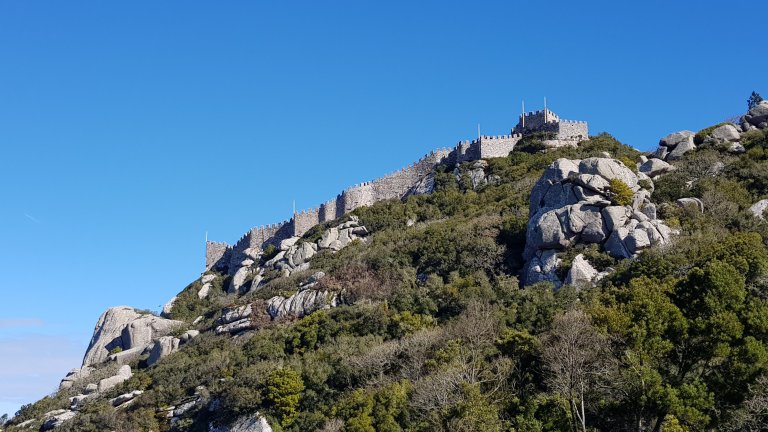
North of Lisbon – Sintra-Cascais: The Parque Natural de Sintra-Cascais offers tremendous contrasts. Inland it protects the high granite dome of Sintra Mountain, with world-class bouldering and the tall granite slabs surrounding its Moorish castle. Heading out to the coast you reach Cabo da Roca, jutting proudly out into the Atlantic, the most westerly point on the European mainland. We didn’t get to sample the impressive granite cliffs (through the weather and some guidebook ambiguity) but the easy-access CASCAIS offers a much more amenable hit of seacliff action. Whilst you’re in the vicinity, it’s worth a trip into Lisbon city, not least as the centre of Portugal’s excellent craft beer movement (though rumour has it there are other cultural highlights to explore too!)

North of Centre – Serra do Sico: Heading north from Lisbon, the climbing is a bit less concentrated, with a cluster of crags in the Serra do Sico near Coimbra. VALE DE POIOS is perhaps the pick of these, but there would be enough to occupy you for a week in a fairly small radius. On the way, check out REGUENGO DO FETAL and the unlikely story of the pilgrimage of Our Lady of Fatima. On the coast there are some of the most fabulous beaches and van-parking spots you could possibly wish for.


The North – Serra da Estrela and Serra de Passos: The Serra da Estrela contains the highest point in Portugal, Torre (1,991m) and as well as a somewhat incongruous / optimistic ski resort, and is home to some fine granite climbing including the magnificent CANTARO MAGRO. Further north, somewhat out on a limb but well worth the visit, is the spectacular quartzite crag of SERRA DE PASSOS though the approach drive is not for the feint-hearted. Fabulous van parking spots near both.


Guidebook: Our two visits were inspired and informed by the excellent select guide by Carlos Simes, published by Versante Sud, in fact the original inspiration for our first trip was bumping into Carlos at the refugio in Chulilla whilst he was editing the text. The book is sprinkled with great background about the local regional culture in each area, as well as inspiring action photos, and useful beta on parking location and of course topos. The only criticism would be that sometimes the crag approach is left somewhat to the imagination, and we’ve tried to fill some of these gaps in the relevant blog posts.
Other hints & tips: Portugal is a wonderfully welcoming country, and has a long-standing affection for Brits, in part based on the Anglo-Portuguese Alliance (or “Luso-English Alliance”) which is the oldest alliance based on known history in the world that is still in force by politics. The language is close enough to Spanish to get by if you have a smattering, so long as you take care to grab a few extra basics like thank you (Obrigado). The food is excellent, especially the seafood (no surprise) and great value. The same can be said of the camping, which seems remarkable cheap even compared with Spain, and providing you are sensible there is a good tolerance of discreet van parking (perhaps the two are linked). One potential cause for confusion is the toll road system, much of which relies on automatic number plate recognition, for which you need to register your vehicle at one of the booths near the border. It’s pretty seamless – just google before you go.
Those are the headlines – now have a browse of the map (above) or a dig into the blog posts to get your trip planned. Enjoy!
 RockAroundTheWorld